
TILE ROOFING
Can You Walk on a Tile Roof in Phoenix? What Breaks and Why
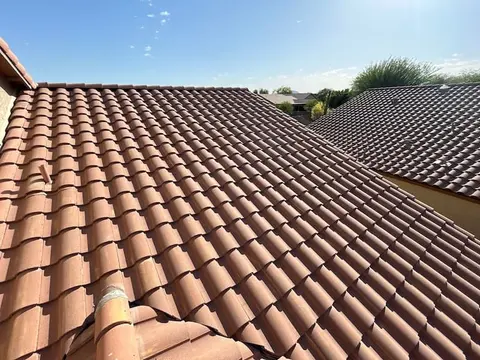
The short answer: yes, a tile roof can be walked, but only by someone who knows where a tile is supported and where it is spanning air. Concrete and clay tile carry weight well at the lower edge, where each piece rests on the one below it, and break at corners, side edges, and unsupported middles. We tell homeowners to stay off entirely, because one wrong step cracks a tile you may not find until it leaks.
A lot of the broken tile we replace in the Valley was not broken by weather. It was broken by a person, usually one who was up there to work on something else. Here is why tile breaks under a foot, who is doing the damage on Phoenix roofs, and how to protect yours the next time somebody has to go up.
Can You Walk on a Tile Roof Without Breaking Tiles?
Usually, if you step in the right places, in soft-soled shoes, at a slow pace. Nobody does it perfectly, though. Even a careful crew cracks a tile now and then, which is why a good one carries spares and replaces what it breaks before it leaves. A careless one leaves a trail of cracked tile from the ladder to the air conditioner.
Why Tile Breaks Under a Foot
A roof tile looks like it is lying flat on the roof. It is not. The top of each tile hangs on a wood batten or is fastened near its upper edge, and the bottom rests on the course below it. In between, the body of the tile bridges open air.
Concrete and fired clay are both strong when you squeeze them and weak when you bend them. Put your weight where the tile has something solid under it and it holds. Put the same weight where it is bridging a gap and the tile has to bend, which it cannot do. It snaps.
That gives every tile strong spots and weak spots:
- Strong: the bottom three or four inches, where the tile overlaps and sits on the tile beneath it.
- Weak: the upper and middle part of the tile, where nothing is underneath.
- Weakest: the corners, and on flat tile the thin side edge where one piece interlocks with its neighbor.
Concrete tile weighs roughly 9 to 12 pounds per square foot of roof, so it is easy to assume something that heavy can take a person. But tile is built to shed water and stand up to sun and wind. It was never designed as a floor.
Where Roofers Step, and Where They Don’t
This is here so you can tell whether the person on your roof knows what they are doing. It is not a how-to.
On flat tile, the step goes on the lower few inches of the tile, over the overlap, and away from the side interlock.
On S-tile and barrel profiles like the roof in the photo above, the foot goes across the high points of the tile, close to the lower edge, turned roughly parallel to the ridge so the heel lands on one crown and the ball of the foot on the next. Two tiles share the load instead of one.
Either way the weight goes down gently. This is the same guidance tile manufacturers give installers.
The places experienced people avoid tell you just as much:
- Cut tile at valleys and hips. These are partial pieces with less support under them.
- Ridge and hip caps. On older Valley roofs these are often set in mortar, and the mortar cracks under a boot.
- The edges. The first course at the eave and the tiles along a gable edge have less holding them.
- Around pipes, vents, and skylights, where tile has been cut to fit.
- Any tile that is already cracked.
On a fragile roof, a careful crew goes further. Foam pads or walk boards spread the load across several tiles, and on the most delicate clay roofs the right move is to lift a path of tile instead of gambling on every step.
Concrete, Clay, and Lightweight Tile Are Not the Same Underfoot
Standard concrete tile is on a huge share of Valley tract homes built since the 1980s, and it is the most forgiving of the three. It still gets more brittle with age. A tile that has baked through thirty Phoenix summers does not take a misplaced step the way a new one does.
Clay tile is more brittle than concrete from day one. You see a lot of it in older parts of Scottsdale like McCormick Ranch and Gainey Ranch, in Paradise Valley, and on custom homes across the north Valley. The bigger problem with clay is what happens after a break: many older profiles are out of production, so a cracked piece may have to be replaced from salvage.
Lightweight concrete tile is the one that surprises people. It is made for houses whose framing was not designed to carry standard tile, often homes that were converted from shingle. It looks like regular tile from the ground and breaks far more easily underfoot. If your home was reroofed from shingle to tile at some point, tell every trade that goes up there.
Who Is Actually Breaking Tiles on Valley Roofs
It is almost never the homeowner, and it is rarely one person. It is a slow pile-up of trades, each of whom cracks a tile or two and does not mention it. Phoenix roofs see a lot of this traffic, for a few local reasons.
Rooftop air conditioning and coolers. Many Valley homes have a packaged AC unit or an evaporative cooler sitting on the roof. That equipment gets serviced every year, often in a hurry on a hot day, by people carrying tools and parts along the same path from the ladder every time. That path is one of the first places we look for broken tile.
Solar. Install crews carry panels and rails across the roof, and every mount means tile gets lifted, cut, or drilled. Breaks under an array are the hardest kind to find, because nobody can see them.
Pigeon control. Pigeons love the shade under solar panels and the open ends of eave tile. The crews that install mesh and spikes spend a lot of time kneeling on the tile.
Holiday lights. From October into December, installers are clipping lights along ridges and eaves all over the Valley.
Everyone else. Painters reaching a second-story wall from a lower roof, satellite and internet installers, skylight cleaners.
One trade stands out for the opposite reason: many Arizona home inspectors will not walk a tile roof at all. They view it from a ladder at the eave or with a drone and say so in the report. That is a reasonable call, but it means a home inspection is not a close look at every tile.
What One Cracked Tile Leads To
On a tile roof, the tile is the armor and the underlayment beneath it is the waterproofing. That is why a cracked tile does not leak the day it cracks, and why the damage is so easy to ignore.
A hairline crack in a tile that is still sitting in place can ride along for years. The trouble starts when a corner falls away or a broken piece slides out. Now a patch of underlayment that was made to live in the shade is sitting in direct sun, on a roof surface that runs 150 to 180 degrees on a July afternoon. That spot dries out and cracks far sooner than the protected underlayment around it.
A careless step can also slide a tile out of place without breaking it. On many older roofs the tile hangs on the battens and is not fastened piece by piece, so a push from a boot opens a gap above it.
Then a monsoon storm drives rain sideways into the opening, and a stain shows up on a ceiling. By then it may have been two or three years since the step that caused it, and nobody connects the leak to the AC service call. We covered how underlayment ages in our post on how long tile roof underlayment lasts in Arizona.
Caught early, this is one of the simplest jobs we do. Replacing a handful of broken tiles and checking the underlayment beneath them is a small tile roof repair. Left alone until the underlayment is cooked, the same spot becomes a leak repair with wet decking and drywall attached to it.
Why We Tell Homeowners to Stay Off
First, you can get hurt. Even a single-story eave is high enough to put you in the hospital. Tile is slick when wet, and dusty tile is slicker than it looks. After a haboob, every roof in the Valley is dusty. Second, you will probably break something.
You can learn a lot without leaving the ground. Walk the perimeter with binoculars or your phone’s zoom and look for:
- Pieces of tile in the yard, on the patio, or sitting in a valley
- A missing corner, or a dark gap where a tile has slid down out of line
- Cracked or missing mortar along the ridge
Do that walk after any trade has been on your roof, while you still remember who it was.
How to Protect Your Roof When Someone Has to Go Up
A few habits keep a service call from costing you tile.
- Ask before the job starts. Who is going on the roof, have they worked on tile, and what do they do when they break one? You want to hear that they tell you and replace it. Put that question to a solar company in writing before you sign.
- Take photos first. A few phone shots of each roof slope from the ground give you something to compare against afterward.
- Keep your spare tile. Many Valley homes have a stack of leftover tile behind the garage or along a side wall. That stack is the easiest source of a matching replacement.
- Get the roof looked at after big rooftop jobs. A new AC unit, a solar install, or a whole-house repaint is a good time for a roof inspection. With solar, have it checked before the panels go on as well, since that part of the roof is hard to reach afterward.
Frequently Asked Questions
Can you walk on a concrete tile roof?
Yes, with care. Concrete tile holds weight at its lower edge, where it rests on the tile below, and breaks if you step on the unsupported middle, a corner, or a side edge. Old tile and lightweight tile break more easily.
Can you walk on a clay tile roof?
Only when necessary, and only someone experienced with clay. It is more brittle than concrete, and replacement pieces for older profiles can be hard to find.
Is it safe to walk on my tile roof to hang Christmas lights?
We would not. Most lights can be clipped along the eave from a ladder without anyone standing on tile. If the design needs someone on the roof, hire an installer who works on tile and ask how they handle breakage.
Will one cracked tile make my roof leak?
Not right away. The underlayment under the tile is the waterproof layer. But once a broken tile lets direct sun reach it, that spot wears out much faster than the rest of the roof, and that is where the leak eventually starts.
Want Someone to Check Yours?
If you have had AC work, solar, or any other trade on your roof and want to know what they left behind, we will walk it the right way, photograph anything that is broken, and show you before recommending anything. Call Pinnacle Roofing at (623) 792-5497 for a free inspection.