
TIPS
New Construction Roofing in Phoenix: What to Ask Your Builder
The short answer: ask your builder five things before the roof goes on. What underlayment is under the tile and what temperature it is rated for. Who the roofing subcontractor is and what their Arizona ROC number is. How the roof is flashed where it meets stucco walls and parapets. What the flat sections are made of and how they drain. And which tier of the builder’s warranty the roof sits in, because on most new Phoenix homes it is the shortest one. The tile color is the decision the design center hands you. These are the ones that decide how long the roof lasts.
A new roof on a new house should be the one roof in the Valley nobody has to think about. The deck is fresh, the framing is square, and no previous roofer has left a bead of caulk where flashing belongs. And yet a good share of the underlayment replacements we do are on homes built in the early 2000s. Those roofs were specified to a minimum and installed to a schedule, and the owners never knew there had been a decision to make.
What should I ask my builder about the roof on a new Phoenix home?
A builder who answers these easily has thought about the roof. One who has to go find out has told you something too.
1. What underlayment goes under the tile, and what is it rated for?
This is the one we would fight for. On a tile roof the tile is a sun shade and the underlayment on the deck is the actual roof. Our summers put that layer through afternoons at 150 to 180 degrees under the tile, and that heat is what ends most Valley tile roofs. The tile is a fifty-year product. Standard 30-pound felt under it is a fifteen-to-twenty-year product here, so the roof fails from the inside while the tile still looks new from the street.
A production builder’s spec sheet lists the tile manufacturer and the color. It usually does not say what is under it, and the design center cannot tell you. So ask for the product name and read the data sheet yourself. What you want to see is a sustained-temperature rating above 250 degrees, which is the number that predicts performance in Arizona. A self-adhered SBS membrane at the eaves, valleys, and walls over a high-temperature synthetic in the field is what we put on new roofs. We laid out the comparison in which underlayment is best for a tile roof in Arizona.
What is the pitch? A lot of Valley tract housing is drawn at 3:12 or 4:12 to keep the roofline low. Below 4:12 the residential code wants two layers of underlayment under tile, or a self-adhered membrane approved as a single-layer system, because at that slope the underlayment is the primary water barrier. Ask where the plan sits and what the spec does about it.
How long will it sit in the sun before the tile goes on? The tile gets stocked on the roof in stacks and laid when the schedule says, and if the next lot slips, that underlayment can sit uncovered through weeks of summer. Felt has almost no UV tolerance. Synthetics carry a rated exposure window on the data sheet, and it is worth knowing whether the schedule fits inside it.
2. Who is actually installing it?
Your contract is with the builder, who holds a general contractor’s license. The roof will be installed by a roofing subcontractor with their own Arizona Registrar of Contractors license in a roofing classification, and that sub is the company whose workmanship warranty you will be relying on in year three.
Ask for the sub’s name and ROC number before the roof goes on, and look them up on azroc.gov. We walk through what to check in our guide to choosing a roofing contractor in Phoenix.
Then ask who is doing the flashing. On a lot of Valley tract homes the roofer installs the roof, the stucco crew installs the stucco, and the joint between them belongs to nobody. That joint is where a large share of the leaks we repair on fifteen-year-old houses start.
3. How is the roof flashed where it meets the walls?
Phoenix houses are stucco, and Phoenix roofs run into stucco everywhere: a second story coming down to a first-story roof, a garage roof dying into the main house, a patio cover tied into a wall, a parapet around every flat section.
The right detail on a sloped roof is step flashing that runs up behind the lath and paper before the stucco goes on, with a kickout flashing at the bottom of the run that throws water clear of the wall. The detail we find constantly on 1990s and 2000s Valley homes is tile run tight to the finished stucco and sealed with a bead of caulk. In our UV, caulk is a two- or three-summer product. After that, every monsoon storm pushes water behind the wall.
Ask specifically about three spots.
- The kickouts, at the bottom of every roof-to-wall run. Ask to see them on the pre-drywall walk.
- The dead valleys, where a lower roof meets a wall and a second slope at once and creates a pocket with nowhere to drain. The plan should avoid them or put a cricket and a wide self-adhered membrane in them.
- The penetrations. Plastic pipe boots crack from UV in a handful of summers. Metal jacks with a UV-stable collar last. It is a small line item that decides whether someone is on your roof in year six.
4. What are the flat sections made of, and how do they drain?
A Pueblo, Santa Fe, or contemporary design in the Valley can be mostly flat roof behind parapets, and even a tile house usually has a flat patio section somewhere. Those sections are where a new house leaks first, for two reasons that trace back to bid day.
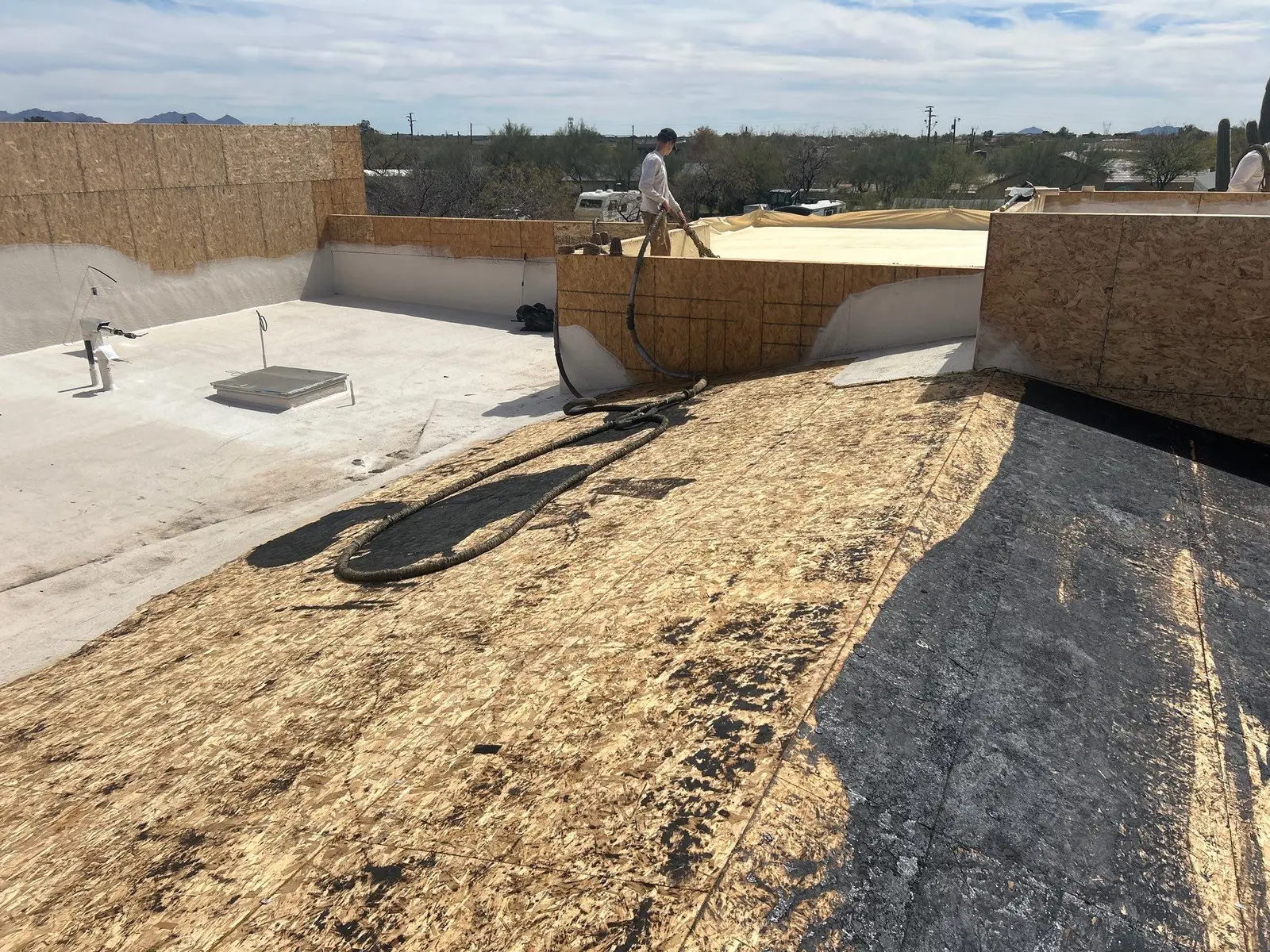
The material. The default on many builder specs is a rolled mineral cap sheet or a modified bitumen membrane, because it is the cheapest thing that passes inspection. It also has seams, and our heat works every seam. We install sprayed polyurethane foam with an elastomeric coating on flat sections, because it has none, it insulates, and it is what most of those rolled roofs get replaced with around year fifteen anyway. The photo at the top of this post is a new build getting exactly that, and our foam roof installation page covers how it goes on. The honest tradeoff is that foam needs its coating renewed on a schedule, a maintenance item the builder will not mention. We covered it in how often to recoat a foam roof in Phoenix.
The drainage. Water on a flat roof has to leave on purpose. Ask what the slope to drain is (a quarter inch per foot is the floor), where the scuppers are, and whether there are overflow scuppers above them. The code requires an overflow path anywhere a parapet could hold water if the primary drain clogs, and in a city that gets a haboob a few times a summer, the primary drain will clog. Ask about crickets between scuppers and behind any rooftop equipment.
If a packaged AC unit is going on the flat roof, ask about the curb height and where the condensate drains. The curbs under rooftop units are where most flat-roof leaks in the Valley start.
5. Which tier of the warranty is the roof in?
Many Arizona production builders write their warranty in three tiers: one year on workmanship and materials, two years on systems like plumbing and electrical, and ten years on the structure. The roof covering usually sits in the one-year tier. The roof you will live under for twenty years or more is the builder’s responsibility for about twelve months. Ask which tier yours is in and get the answer in writing.
After that you are relying on two other warranties, so ask for both. The roofing sub’s workmanship warranty, with its term, from the sub. And the manufacturer’s material warranty, which on tile and underlayment can be long but may require a registered installer and a registration at closeout. Our new construction roofing page describes how we handle that paperwork.
Arizona law also gives a new-home buyer an implied warranty of workmanship and habitability, and the Purchaser Dwelling Act sets a written-notice-and-repair process with the builder before a defect dispute goes further. A construction attorney is the right person for the rest.
Production, custom, and owner-builder: the questions shift
Production home. The roof spec is set for the whole community and the design center choice is tile color. You will not change the underlayment on a single lot, but questions one, two, and five tell you what you are buying before you sign. Questions three and four are what to look at on the pre-drywall walk, while the flashing and crickets are still visible.
Custom home. Everything is on the table, including the system. Standing seam metal is the longest-lived option and the one we would put on our own house, and it belongs in the plan early because it changes the fascia, gutter, and flashing details. Our metal roof installation and new tile roof installation pages cover both. If a flat section is in the design, specify foam at the plan stage rather than accepting the default membrane. And since most Valley houses are built without gutters, decide on purpose where the water off each eave is going to land.
Owner-builder. Arizona lets you act as your own general contractor on a house you will live in, so you are hiring the roofer directly and every question above is yours to ask. Add sequencing: get the deck dried in and the tile laid in a tight window, and if that window falls between June and September, plan for monsoon storms on an open deck.
If we could change one thing about how new homes get roofed in the Valley, it would be who picks the underlayment.
Before you close, get the roof looked at
The city’s roof inspection is a code check. It happens before the tile is loaded and it looks at deck nailing and underlayment laps against the minimum. Neither one lifts a tile or looks at a kickout.
Have someone walk the roof who knows what to look for, ideally right before the one-year warranty tier closes, so anything found is still the builder’s to fix. A real roof inspection on a new house is short, because there is little to find on a roof that was built right, and what there is to find on one that was not is cheap to fix while someone else is paying.
Frequently asked questions
Who is responsible for a roof leak on a new home in Arizona?
Inside the builder’s workmanship warranty period, the builder, who will usually send the roofing subcontractor. After that, the sub’s workmanship warranty and the manufacturer’s material warranty.
What is the best roof for a new home in Phoenix?
Tile over a high-temperature underlayment for pitched roofs, foam with an elastomeric coating for flat sections, and standing seam metal where the budget and design allow it. The material on top matters less than the underlayment, flashing, and drainage underneath it.
Can I hire my own roofer on a production home?
Almost never. The builder’s trade contracts are set for the community. On a custom home or an owner-builder project, yes.
Building in the Valley?
If you are planning a custom home, acting as your own builder, or have a one-year warranty walk coming up, we will look at the roof with you and tell you what we see. Call Pinnacle Roofing at (623) 792-5497 for a free inspection.