
MAINTENANCE
What Does a Phoenix Roof Inspection Actually Cover?
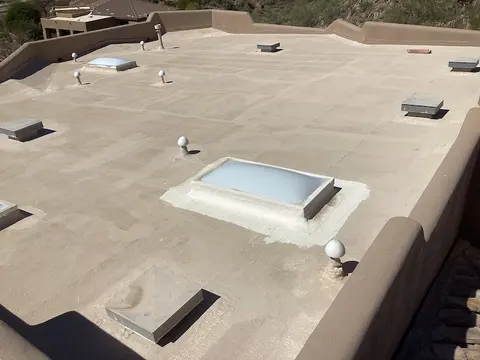
The short answer: a real roof inspection in Phoenix is a walk on the roof, a look under the surface where the roof actually fails, a look in the attic, and a written report with dated photos and a plain recommendation. On tile that means lifting tiles to see the underlayment. On foam it means checking the coating and testing for trapped moisture rather than judging by color. A free inspection from a roofer is worth exactly as much as the evidence it hands you, and a good one will sometimes tell you nothing needs doing.
What does a roof inspection actually cover?
People book a roof inspection expecting someone to look at the roof. The useful part is what happens after the looking: what gets lifted, what gets photographed, and what ends up in writing. A roof that looks fine from the driveway is the normal condition of a failing Phoenix roof, so an inspection that stops at the driveway has not started. Here is what ours covers, and what any inspection in the Valley should.
The walk, the lift, and the attic
The walk. The inspector gets on the roof and covers all of it, not only the slope facing the street. The spots that fail first here are the ones nobody sees: the back valley, the dead valley behind a second-story wall, the low spot where a patio roof ties into the house. A drone fills in what cannot be walked safely, and we use one where it helps, but a drone cannot lift a tile or push on a soft spot.
The lift. This is what separates an inspection from a look. On a tile roof the waterproofing is the underlayment on the deck, and the tile is a sun shade on top of it. Our summer puts that underlayment through afternoons at 150 to 180 degrees under the tile, so it goes brittle long before the tile shows any age. The only way to know its condition is to lift tiles in several places (eave, field, valley, wall) and look. If it is still pliable, the roof has life. If it cracks when flexed or crumbles at the fastener holes, the roof is on the clock regardless of how the tile looks. Anyone who calls a tile roof “fine” without lifting tile has told you nothing; see why Phoenix tile roofs leak while the tiles look perfect.
The attic. Water shows on the underside of the deck months before it shows on a ceiling, because it has to soak through insulation and drywall first. We look for staining and rust tracks around every penetration, daylight at pipe jacks and vents, and the condition of the sheathing. Valley attics also carry the ductwork, so a wet attic is a duct problem too. In summer the attic runs well over 130 degrees, which is why a lot of inspections skip it. Ask whether yours includes it.
What gets checked, by roof type
Tile (concrete and clay). Beyond the underlayment lift: cracked, slipped, and missing tiles, especially along the paths where an AC tech or a holiday-light crew has walked (we covered that traffic in can you walk on a tile roof). The eave closure, sometimes called bird stop, because broken closures let pigeons nest on top of the underlayment. Mortar at the ridges and hips, which cracks and lets wind-driven rain in. Valley metal, and whether the tile is cut cleanly to it or sitting in the water path. And the mastic patches smeared around penetrations by a previous roofer or AC tech, which hold for a season and then split.
Foam and coated flat roofs. The coating is the roof’s sunscreen, and our UV eats it. We look at chalking and thinning on the south and west exposures, and at yellowed foam where the coating has worn through. Blisters, which point at moisture under the coating. Ponding, meaning standing water more than two days after a rain, which usually traces to a clogged scupper. Then the moisture test: a foam roof can look uniform and be saturated in one corner, so we probe and meter rather than trust the surface. The curbs under rooftop AC units get a close look, because that is where most flat-roof leaks in Phoenix start, and so does any evaporative cooler, because years of bleed-off water across foam leave a mineral trail and a soft spot. Our foam roof repair work almost always starts at one of those two places.
Shingle and metal. Shingles age fast in our sun: curling, granule loss in the gutters, cracked tabs on the south slope, and seal strips that let go in heat and leave shingles free to lift in a monsoon gust. On metal it is the seams, the sealant at every penetration, and on exposed-fastener panels the screws, because daily expansion ovals the holes and bakes the rubber washers.
Every roof. Flashing at walls and chimneys, including the stucco-to-roof joint that Valley builders often finished with a bead of caulk and nothing else. Skylights, vents, and pipe jacks, which crack from UV before anything else on the roof. Gutters and scuppers, which fill with dust between rains and overflow in the first monsoon storm. Soft spots and sag in the deck.
What the report should hand you
Everything above is worthless if it stays in the inspector’s head. The deliverable is the report, and it should contain:
- Dated photos from on the roof, including the underlayment with tile lifted. If a company will not show you what is under the tile, assume they did not look.
- A map of where the problems are. “Southwest valley, second from the chimney,” not “some tiles need attention.”
- A split between urgent and routine. An open valley that will leak in the next storm is a different item than a coating with three good years left.
- A plain recommendation: repair, maintain, or replace, with the reasoning attached. “Replace” without “because the underlayment failed in four of six lift points” is a sales line, not a finding.
- A statement of what was not inspected and why. Roof too steep to walk, attic sealed, solar array covering a slope.
If the report is for an insurance claim, it has to do one more thing: separate what a storm did from what age did, because adjusters will. We explain that split in our post on whether homeowners insurance covers a Phoenix roof.
What is a free roof inspection worth?
A free inspection from a roofing contractor is a free estimate. The company is spending an hour on your roof because they would like the work if there is work, and there is nothing wrong with that as long as everybody is clear about it. The value is entirely in the evidence it leaves behind. If you get the photos, the map, and the written recommendation described above, you got something worth paying for and did not have to. If you get a verbal “you need a new roof” and a number, you got a sales call. A few things tell the two apart.
Who initiated it. An inspection you booked is a service. An inspection offered at your door after a storm, from someone “working in the neighborhood,” is lead generation, and the Valley fills up with it every September. Do not sign anything on the doorstep, and never anything that assigns your insurance claim to the contractor.
Whether they ever say “nothing.” A company whose free inspections find a full replacement on every roof is not inspecting. We walk plenty of roofs that need a few tiles and a pipe boot, and some that need nothing, and we say so. The homeowner who hears “you are fine, call us in five years” is the one who calls us in five years.
Whether they lifted tile. The single best test of an inspection in this market.
Whether the license checks out. Any roofer on your roof should hold an Arizona Registrar of Contractors license in a roofing classification, and the ROC’s public search on azroc.gov shows the status and any complaints in about thirty seconds. Ours is AZ ROC #161685, and we have been inspecting Valley roofs under it since 1999.
One more kind is worth knowing about. In a home sale, a buyer can pay an independent roof consultant so the person reporting has nothing to sell. The standard Arizona resale contract gives the buyer a limited inspection period, usually ten days, so schedule it early. And many Arizona home inspectors will not walk tile at all. They view it from the eave or by drone and note that in the report, so the roof section of a general home inspection on a tile house is a look, not an inspection. A buyer in Anthem, Surprise, or Gilbert with a twenty-year-old tile roof should get the tile lifted by somebody before that period closes.
When to get one in Phoenix
The usual triggers are buying, selling, an age milestone, or the first stain on a ceiling. The Valley calendar adds two of its own.
October. Monsoon season officially ends on September 30, and October is when the damage becomes visible: tiles lifted by outflow winds, foam punctured by debris, scuppers packed with haboob dust. It is also the last comfortable month on a roof before the winter rains, which test a roof differently. Monsoon rain is sideways and brief. A Pacific storm in January is gentle and lasts two days, and it finds the slow leaks that the summer storms rushed past.
May. The month before monsoon, for the opposite reason: fix the open valley now rather than during the first storm in July. Our monsoon roof checklist covers what you can check from the ground yourself.
Between those, once a year is the right cadence for most Valley roofs, and twice a year for foam past its first recoat and tile past year fifteen. A standing roof maintenance schedule bundles the inspection with the small fixes it turns up.
What an inspection cannot tell you
An honest inspection has limits, and a good inspector says so. It cannot see under a solar array without the panels coming off. It cannot tell you the exact year the underlayment will fail, only where it sits on the curve; we laid out that curve in how long tile roof underlayment lasts in Arizona. And it cannot tell you what the deck looks like beyond the spots where tile was lifted, which is why every remove-and-reset proposal should include a plan for deck repair found after tear-off.
What it can do is replace guessing with evidence, which is the difference between a small repair this fall and a drywall bill next summer.
Frequently asked questions
What is included in a roof inspection?
A walk of the full roof, a look under the surface (tile lifted on tile roofs, moisture testing on foam), the attic, every flashing and penetration, drainage, and the deck, then a written report with dated photos and a repair, maintain, or replace recommendation. On our Phoenix roof inspections the estimate for any work is part of the same visit.
How often should a roof be inspected in Arizona?
Once a year for most roofs, and twice for older tile and foam. The best single month is October, after monsoon damage is done and before winter rain.
Can a roof inspection be used for an insurance claim?
Yes, if it is written for that purpose: dated on-roof photos, storm damage described separately from wear, and a repair scope. Adjusters respond to documentation, not opinions.
Get eyes on your roof before winter
If your roof has not been looked at since before monsoon season, October is the month. We will walk it, lift tile, check the attic, and send you the photos and a written recommendation whether or not there is anything to fix. Call Pinnacle Roofing at (623) 792-5497 for a free inspection.