
MAINTENANCE
Roof Recoating in Phoenix: How to Recoat a Flat Roof
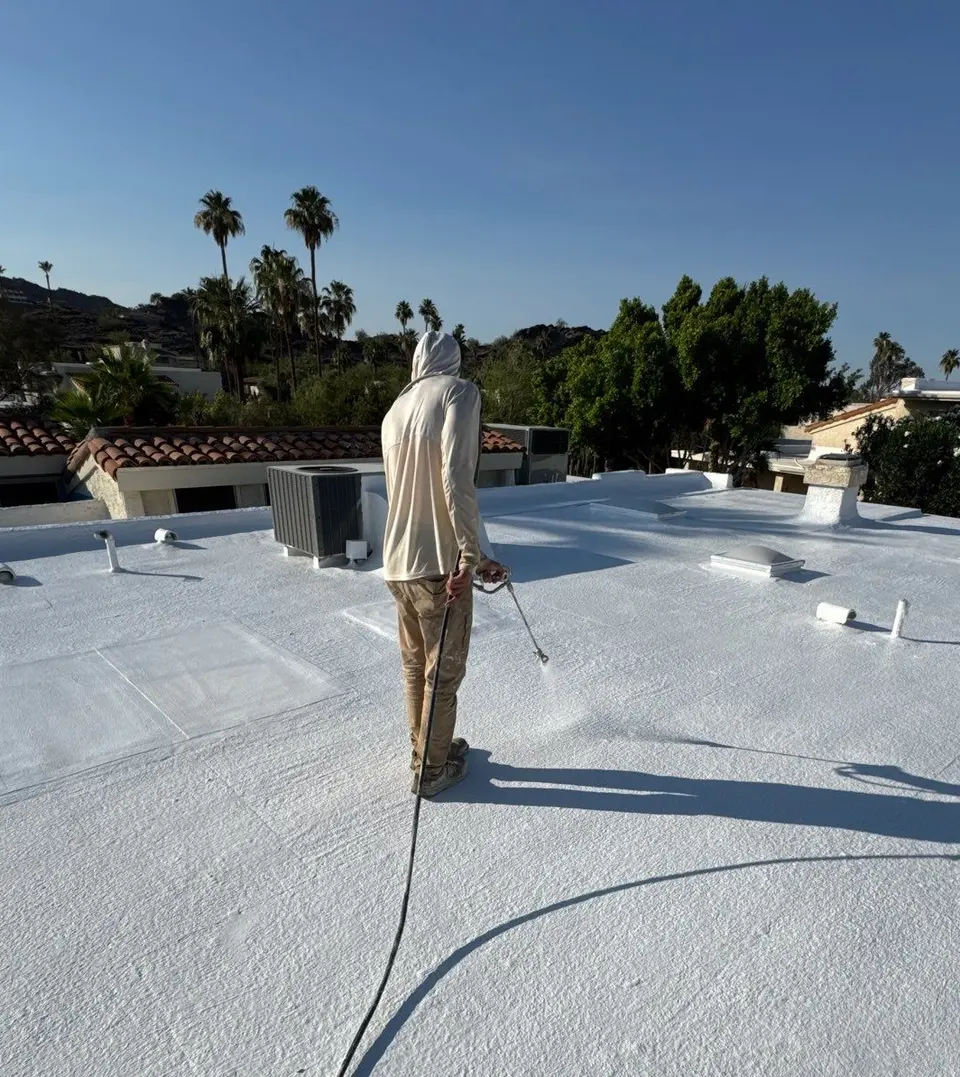
The short answer: recoating works when the roof under the coating is still dry and sound. You are replacing the sacrificial top layer, not fixing a failed roof. Done on schedule, a recoat buys another 5 to 10 years for a fraction of replacement cost. Done on a roof that is already wet underneath, it buys nothing and hides the problem.
What Recoating Actually Is
A flat roof in the Valley is usually a foam or single-ply system with a coating on top. The coating is the part that faces the sun, and it is designed to wear out. That is its job. It takes the UV so the roof underneath does not.
So recoating is not a repair. It is scheduled maintenance on a consumable layer, closer to repainting a house than to replacing a roof. Skip it long enough and the coating thins, the substrate starts taking UV directly, and you move from a maintenance bill to a replacement bill.
That distinction is worth holding onto, because it explains both why recoating is such a good deal when it is done on time and why it is a waste of money when it is done too late.
When Recoating Works, and When It Is Money Wasted
Recoating is the right call when the coating is worn but the system beneath it is dry, adhered, and structurally intact. Fading, chalking, thin spots, minor surface cracking, and a general loss of reflectivity are all normal end-of-cycle wear. That is a roof asking for its next coat.
Recoating is the wrong call in three situations, and an honest contractor will tell you so.
The foam or insulation is wet. Once water is in the system, coating over it seals the moisture in. It has nowhere to go, it keeps working on the substrate, and you have spent real money making the problem invisible. Wet areas have to come out and be replaced before anything gets coated.
The substrate has failed, not just weathered. Deep cracking through to the foam, large blisters, delamination, or crushed areas from foot traffic are repair work first. Coating is not structural and will telegraph whatever is underneath.
There is standing water that never leaves. More on that below, because in Phoenix it is common enough to deserve its own answer.
The way you tell the difference is a moisture survey, not a visual. A roof can look uniformly tired from the ladder and be soaked in one corner. If somebody quotes you a recoat off a photo, that is not an inspection.
The Phoenix Part
Three things about recoating here are genuinely different from how it works elsewhere.
Foam is everywhere. Sprayed polyurethane foam is a niche product in much of the country and a default in the Valley, because it handles our low-slope roofs and the heat well. That means most Phoenix recoats are foam recoats, and foam has its own rules: it is UV-sensitive in a way that most substrates are not, so the coating is not cosmetic protection, it is the only thing standing between the sun and the foam. A bare spot on a foam roof degrades fast.
Dust is an adhesion problem. Most coating failures we get called out to look at are not product failures, they are bond failures, and around here that usually traces back to prep. Valley roofs accumulate a fine dust film constantly, and it gets worse after a haboob. Coating over dust gives you a layer that looks perfect on day one and peels in sheets in year three. Proper washing and, where needed, priming is most of the job, and it is the first thing to get shortened on a cheap bid.
Summer limits when the work can happen. Coatings have application temperature windows, and a Phoenix roof deck in July blows through the top of them by mid-morning. That does not mean summer recoats are impossible, it means the work happens early and the schedule has to respect it. It is also why we would rather not start a coating job with a monsoon cell building, since most products need a dry cure window and a storm rolling through green coating is a redo.
Ponding Water
Our roofs are dead flat more often than roofs anywhere else, and drainage was frequently an afterthought. So ponding comes up constantly.
Short version: standing water that clears within a day or two after a storm is normal and most coatings tolerate it. Water that sits for a week is a design problem, and no coating fixes a design problem. Acrylics in particular do not like long-term immersion, and a chronically ponded area will fail first no matter what you put on it.
If you have a spot that never dries, the useful conversation is about drainage: adding a drain, building up a cricket, or tapering insulation to move water somewhere. That costs more than a coat and it is the only thing that actually works.
Coating Types, at Decision Level
You will hear three families named on quotes.
Acrylic is water-based, reflective, economical, and the most common choice on Valley foam roofs. It handles our UV well and it is easy to recoat over next cycle. Its weakness is standing water.
Silicone handles ponding far better and holds up well in sun. It costs more, it holds dirt (so reflectivity drops as it ages), and recoating over old silicone requires specific prep because not much sticks to it.
Polyurethane is tougher underfoot and takes abrasion better, which matters on a roof with equipment and regular traffic. It is often used as a base coat under something else rather than alone.
There is no universal right answer, and anybody who tells you one product is always correct is selling that product. The choice follows the roof: how it drains, how much traffic it takes, what is on it now, and how long you plan to own it.
What a Proper Recoat Includes
Quotes for this vary wildly, and the reason is almost always what is left out. A complete recoat covers:
- A moisture survey, with wet areas cut out and replaced, not coated over
- Repair of blisters, cracks, and damaged foam before anything else happens
- A real wash, and priming where the existing surface calls for it
- Reinforcement at seams, penetrations, curbs, and parapet transitions, which is where flat roofs actually leak
- The coating applied at a stated thickness in mils, not “two coats”
- A stated warranty from both the manufacturer and the contractor
That mil thickness line is the one to watch. Two coats of a thin application and two coats of a proper one look identical the day the crew leaves and are not the same roof. Ask for the number.
What It Costs
Recoating generally runs in the range of $1.50 to $3.50 per square foot in the Phoenix market, depending on roof size, the condition you are starting from, how much repair is needed first, and which coating system goes down.
That range is for a recoat on a sound roof. Significant foam replacement or drainage work sits outside it. As always, the only number that means anything comes from somebody who has been on your roof with a moisture meter, and we put ours in writing.
For how often this should be happening, we wrote a separate post on the foam roof recoating schedule in Phoenix.
Frequently Asked Questions
How long does a roof coating last in Phoenix?
Plan on 5 to 10 years between recoats, with acrylic at the shorter end and silicone longer. Thickness, ponding, and traffic all move it. Our UV is at the hard end of the range, so a coating here works harder than the same product would in a milder climate.
Is recoating better than replacing?
When the system underneath is dry and sound, yes, clearly. It costs a fraction of a replacement and resets the maintenance cycle. When the system is wet, no, and coating it makes the eventual replacement worse.
Can any flat roof be recoated?
Foam and previously coated roofs are the usual candidates. Some single-ply membranes can be coated with the right primer and some cannot, depending on the membrane type and its condition. Tile and shingle roofs are not candidates at all, whatever anyone selling a coating tells you.
How do I know when mine is due?
Loss of reflectivity is the practical signal: the roof goes from bright to dull and chalky, and a hand run across it comes back white. Thin spots where the substrate color shows through mean you are past due. If your last recoat was five or more years ago, it is worth a look.
Will a recoat stop an existing leak?
Sometimes, if the leak is genuinely through worn coating. More often the leak is at a penetration, a seam, or a parapet, and those need to be detailed properly rather than covered. A recoat that is sold as leak repair without anyone finding the leak first is a coin flip.
Find Out Where Yours Stands
A recoat is one of the better values in roofing when the timing is right, and one of the worse purchases when it is not. The difference is knowable in an afternoon.
We will get on your roof, check it for moisture rather than guess, and tell you plainly whether you are looking at a recoat, a repair first, or a roof that is past it. Call Pinnacle Roofing at (623) 792-5497 for a free inspection, or read more about foam roofing if that is what you have up there.