
TILE ROOFING
How Long Does Tile Roof Underlayment Last in Arizona?
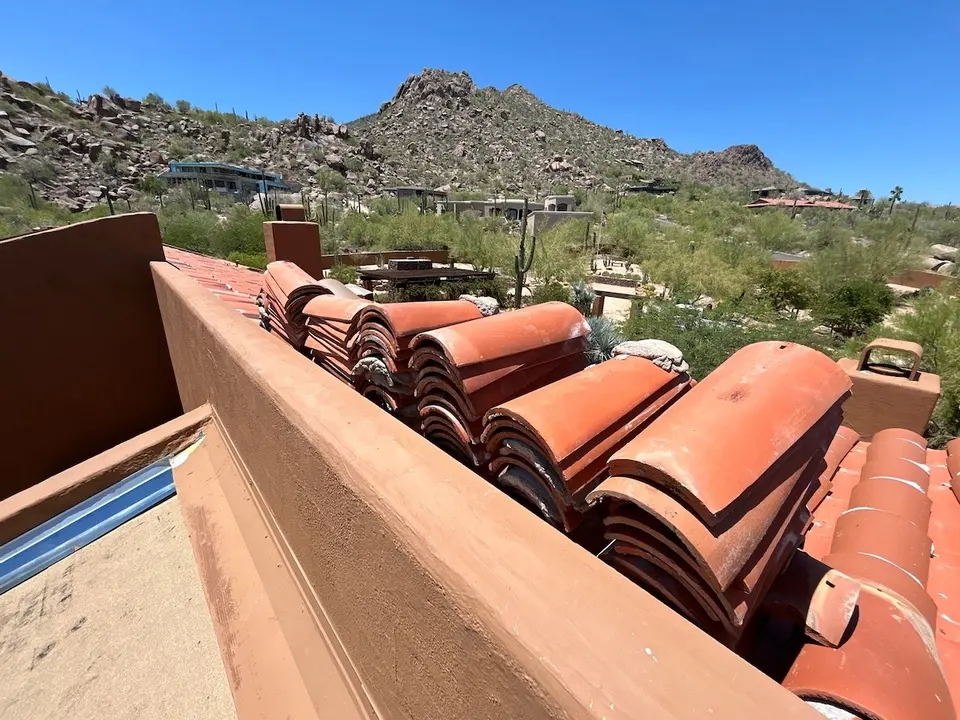
The short answer: in Arizona heat, standard felt underlayment runs about 15 to 20 years, quality high-temperature synthetic 25 to 40, and premium peel-and-stick 30 to 50 or more. The tile above it will outlive all of those, which is why the age of your tile tells you almost nothing about the age of your roof.
It is the question we get asked in almost every driveway conversation in the Valley, usually right after we explain that the tiles are not the waterproofing. How long does the underlayment actually last?
The honest answer is a range, and it is a wide one. In the Phoenix climate, a single layer of 30-pound felt is generally done somewhere between 15 and 20 years. A good high-temperature synthetic will usually run 25 to 40. A quality self-adhered membrane can go 30 to 50 or more. That is a spread of three decades between the worst case and the best, which is not much help if you are trying to decide whether to budget for this next year or in 2040.
The more useful question is where your roof lands inside that range, and why. After enough tile roofs across Phoenix, Scottsdale, Peoria, and Sun City, the pattern is fairly consistent, and most of it comes down to things you can figure out about your own house without climbing a ladder.
In Arizona, Underlayment Dies of Heat, Not Water
Most everywhere else in the country, roofing underlayment fails because it gets wet and stays wet. Ice damming, saturation, freeze cycles, organic growth. Almost none of that applies here.
The Valley gets somewhere in the neighborhood of seven or eight inches of rain in a normal year, much of it in a handful of monsoon storms. Your underlayment spends the vast majority of its life bone dry. What it never gets a break from is heat. On a July afternoon a tile roof surface runs 150 to 180 degrees and the underlayment beneath is not far behind, then it cools overnight and does it again. That is more than 300 expansion and contraction cycles a year, and six thousand over twenty years.
Asphalt-based underlayment is a mat saturated with oils and volatiles, and sustained heat bakes those out. The material goes from flexible to stiff to brittle. We have pulled felt off Phoenix roofs that cracked like a saltine the moment it came loose from the deck, and it had never seen standing water in its life. Synthetic and self-adhered products hold up better because they are engineered for it, but the same clock runs on them.
This is why lifespans quoted in national roofing articles do not transfer here. A felt underlayment rated for 25 or 30 years in Ohio is being asked to do something completely different in Arizona. The failure mode is different, the timeline is shorter, and the warning signs are different too, which is why a tile roof in Phoenix can leak while the tiles above it look perfect.
There is one more Arizona wrinkle worth knowing. Because the roof is dry most of the year, the underlayment only gets tested during monsoon season. A membrane that went brittle in April will not tell you about it until the first wind-driven storm in July, which is why leak calls arrive in a cluster over a few weeks in midsummer from roofs that were already failing months earlier.
Start With the Year Your House Was Built
For most Valley homeowners, the fastest way to estimate where the underlayment stands is to look at the build year, because Phoenix tile roofs come in fairly distinct waves and each wave got a fairly predictable install.
Homes from the original Del Webb-era Sun City and Sun City West development and the tract building through the 1980s and early 1990s got single-layer felt as a matter of course. Any of those roofs still carrying original underlayment are decades past its useful life, and most have already been through at least one replacement. If yours has not, that is the finding, not a guess.
The big one is the late 1990s through mid-2000s boom, when subdivisions went up across Surprise, Goodyear, Buckeye, Anthem, and the north Valley about as fast as anywhere in the country. Standard practice on that stock was 30-pound felt, sometimes doubled, under concrete tile. Do the math on a house finished in 2003 and the underlayment is now past twenty years into a 15 to 20 year life. This is the largest group of roofs we work on today, and the tiles on nearly all of them are still perfectly good.
Homes built after roughly 2010 are a mixed bag. Synthetic underlayment became common and self-adhered membrane started showing up in valleys and at eaves, but the quality range widened. A 2015 house could have a premium two-layer system with decades left or a budget synthetic no better than felt, and the build year alone will not tell you which.
If you do not know your build year, the county assessor record has it. If the house had roof work at some point and you do not know what kind, city or county permit history will often show whether it was a repair, a reroof, or a tile remove and reset.
Six Things That Move Your Number
Two identical houses on the same street, built the same year by the same builder, can be ten years apart on underlayment condition. Here is what accounts for the gap.
Which way the slope faces. South and west-facing slopes take the brutal end of the afternoon sun and fail first, often years before the north side of the same roof. When we lift tiles for an inspection we lift on the south and west first, because that is where the roof tells the truth. The north slope can still look serviceable while the west side is cracked through.
Roof pitch. A lot of Valley tract housing sits at 3:12 or 4:12, which is low for tile. Water moves slowly across a shallow roof and wind-driven rain has more chance to push back up under the tile laps, so the underlayment is doing more of the waterproofing work than it would at 6:12 and any degradation shows up as a leak sooner.
Attic ventilation. Heat trapped under the deck cooks the underlayment from below as well as above. Undersized or blocked soffit vents mean a hotter attic, and a hotter attic ages underlayment faster. This is one of the few factors a homeowner can actually improve.
How the tiles were set. Mortar-set ridge and hip caps are common on older Valley installs, and mortar cracks as the roof moves through its daily temperature swing. Once those joints open, the underlayment underneath the ridge sees direct sun and weather it was never meant to see, and it goes first while the field of the roof is still fine.
Whether tiles have shifted. Any tile that slides, cracks, or goes missing puts a patch of underlayment in direct sunlight, and UV eats it quickly. A broken tile left for two summers can leave a failed spot in an otherwise healthy roof, which is why prompt tile roof repairs are worth more here than people expect.
Install quality. Lap dimensions, fastener placement, how carefully the membrane was run into valleys and up walls, whether the eave and rake edges were detailed properly. A well-installed felt roof will outlast a sloppily installed synthetic one, and this explains a great deal of the variation we see.
What End of Life Actually Looks Like
Underlayment does not fail all at once. It gets brittle, then it cracks around the fasteners, then the cracks connect, then a monsoon storm finds them. By the time a stain shows on a ceiling, the material has usually been compromised for a year or more and water has been reaching the deck that whole time.
What we look for when we lift a tile is whether the membrane is still pliable. Good underlayment bends. Failed underlayment cracks when you flex it, crumbles at the edges, and has often shrunk back from the nail heads and the eave metal. Sometimes there is a fine dark grit on the deck beneath it, which is the felt breaking down into particles. If a section fails that test at the age you would expect it to, the rest of the field is rarely far behind.
The good news is what makes Arizona tile roofs different from almost any other system. Concrete tile lasts 40 to 75 years and clay can go past a century, so when the underlayment is done, the tiles are not. That is why underlayment replacement exists as its own job: the tiles come off and get stacked, the failed membrane comes off, new membrane goes down, and the same tiles go back on. You replace the layer that wore out, not the roof.
Timing It Instead of Reacting to It
If your tile roof is past the fifteen year mark and nobody has looked under a tile, find out where you stand rather than waiting for a storm to tell you. An honest inspection either gives you years of peace of mind or a realistic window to plan in, and both beat a wet ceiling in August.
The other reason to be early is scheduling. Tile work goes better in the cooler months, and the Valley’s roofing calendar gets crowded right after monsoon season when everyone calls at once. A roof identified as marginal in October is a planned project. The same roof identified in July is a problem you did not budget for.
Frequently Asked Questions
How long does felt underlayment last on a Phoenix tile roof?
Generally 15 to 20 years for standard 30-pound felt in our heat, and the low end of that with poor attic ventilation or heavy south and west exposure. Felt was the default on Valley tract housing through the 1990s and into the 2000s, so a large share of homes from that window are at or past the end of it now even though the tiles look fine.
Can I tell how old my underlayment is without getting on the roof?
You can get close. Start with the build year from the county assessor record, then check permit history for any reroof or remove and reset since. If the house is original and built before roughly 2005, assume felt and assume it is near or past the end of its life. Confirming it takes lifting a few tiles, which is a normal part of a tile roof inspection.
Does replacing underlayment mean I need new tiles?
Usually not. Concrete tile lasts 40 to 75 years and clay tile far longer, so on most Phoenix roofs the existing tiles get carefully removed, stacked, and reinstalled over the new membrane. Some breakage happens during handling and gets replaced from salvage or matched stock, but the bulk of the tile goes back on the roof.
Is synthetic underlayment worth it in Arizona?
If it is a high-temperature product, yes. The gap between a quality synthetic or self-adhered membrane and standard felt is roughly ten to twenty extra years here, which is the difference between doing this job twice during your ownership and doing it once. Check that the product is actually rated for sustained high temperatures, since not all synthetics are and the cheap ones do not hold up much better than felt.
When during the year should this work be done?
Fall through spring is easier on everyone. Cooler temperatures are better for the crew and the materials, and getting ahead of monsoon season means the new membrane is in place before the roof gets its annual test. Summer work is common enough, but plan it for the cool season if you have the runway.
Find Out Where Yours Stands
If your tile roof is more than fifteen years old, or you bought the house without knowing its roof history, an inspection will tell you what you are working with and how much time you have. We will lift tiles in the spots that matter, show you photos of what is under there, and give you a straight read. Call Pinnacle Roofing at (623) 792-5497 to schedule a free roof inspection.