
TILE ROOFING
Tile Roof Underlayment: Why Phoenix Roofs Leak
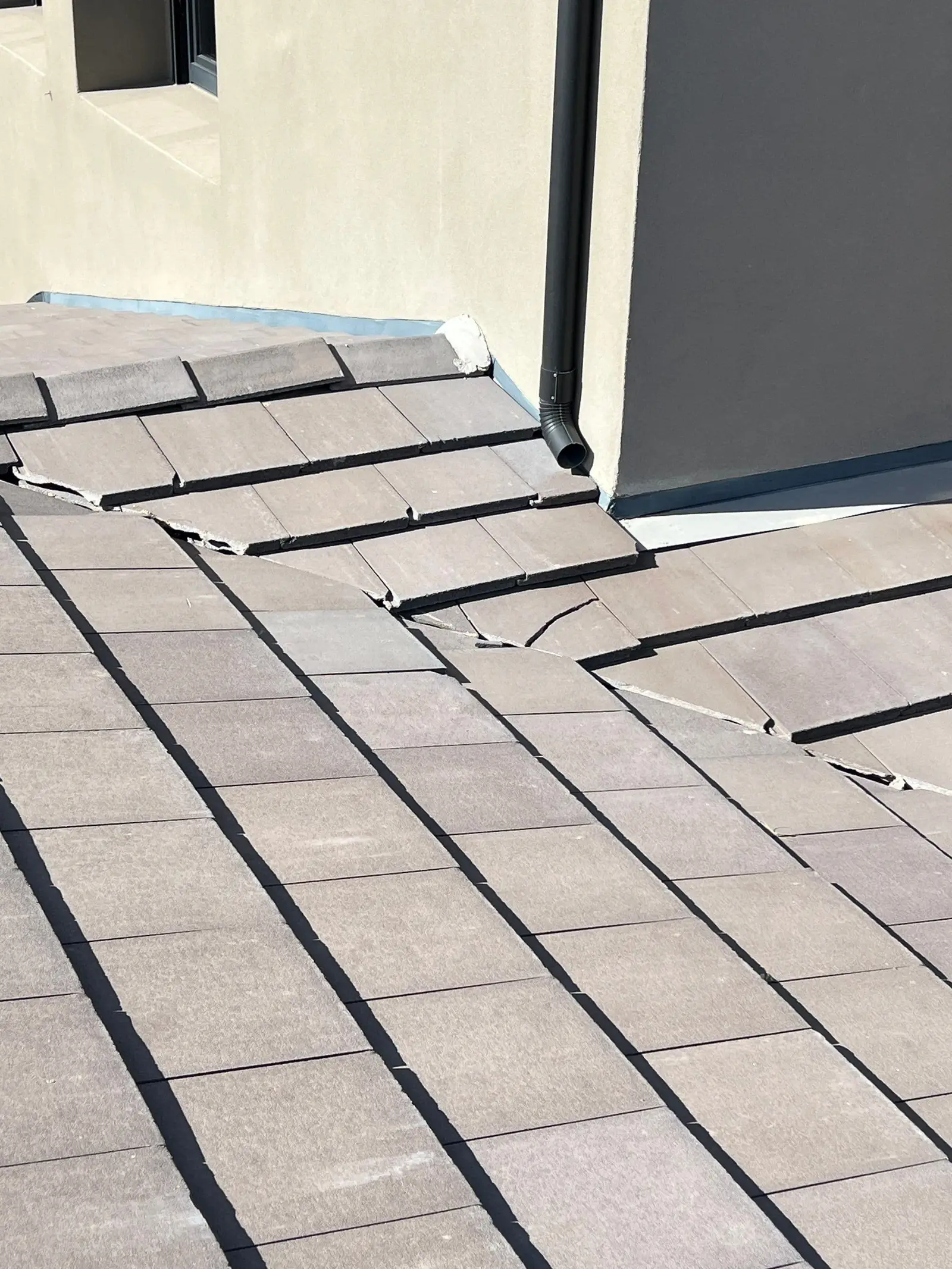
The short answer: your tiles are not the waterproofing; the underlayment beneath them is, and in Phoenix heat it wears out decades before the tile does. That is why a roof can leak while every tile looks perfect. Here is how the hidden layer fails and what to do about it.
The Hidden Layer That Actually Waterproofs Your Tile Roof
Every year we take leak calls from homeowners who are genuinely confused, because their tiles look perfect from the ground. Nothing cracked, nothing missing, roof looks great. Water is still getting in.
The culprit is almost always failed underlayment, and it is the most misunderstood part of tile roofing in Arizona. Your tiles are the first line of defense against sun, wind, and debris. The waterproofing is a layer you have probably never seen.
What Is Roof Underlayment?
Underlayment is a waterproof membrane installed directly on the roof deck, under the tiles. Think of it as the actual roof, with the tiles as a protective shell sitting on top.
From bottom to top, a tile roof is:
-
Roof deck: The structural plywood or OSB sheathing attached to your rafters or trusses
-
Underlayment: One or more layers of waterproof membrane fastened to the deck
-
Battens (in some installations): Horizontal wood strips that create an air gap and provide attachment points for tiles
-
Tiles: The clay or concrete tiles that form the visible exterior surface
Most rain runs off the tile. Wind-driven rain, condensation, and water working between tile overlaps all reach the underlayment anyway. Intact, it carries that water down to the eaves. Deteriorated, it lets the water into the deck and eventually into the house.
Why Arizona Heat Destroys Underlayment Faster Than Anywhere Else
Heat is the number one enemy of roof underlayment, and it degrades the material far faster here than in a moderate climate.
Temperature Extremes on Your Roof
Phoenix air temperatures regularly hit 110°F to 120°F in summer, and the roof itself runs much hotter than that. On a typical July afternoon:
-
Tile surface temperature: 150°F to 180°F
-
Underlayment temperature: 140°F to 170°F
-
Roof deck temperature: 130°F to 160°F
Those temperatures accelerate the chemical breakdown of the material. The oils and volatiles in asphalt-based underlayment bake out over years of this, leaving it dry, brittle, and cracked.
UV Radiation
Phoenix receives some of the highest UV radiation levels in the United States. While the tiles block most direct UV from reaching the underlayment, reflected and indirect UV still contributes to degradation, particularly at edges, ridges, and anywhere tiles may have shifted to create gaps.
Thermal Cycling
The daily temperature swing in Phoenix can be dramatic: from 75°F at dawn to 170°F on the roof surface by 3 PM, then back down overnight. This constant expansion and contraction stresses underlayment materials, causing them to crack, separate at seams, and pull away from fastener penetrations over time. Over the course of a year, your underlayment goes through this cycle more than 300 times.
Types of Underlayment and How They Perform in Arizona
Organic Felt (30-lb Felt Paper)
Traditional 30-pound felt was the standard for decades and sits under a great many Phoenix tile roofs today. It is a cellulose or fiberglass mat saturated with asphalt.
Performance in Arizona: poor to moderate. Felt degrades quickly in this heat, typically running 15 to 20 years before real deterioration. That is why so many roofs from the 1990s and early 2000s are failing now with tiles above them still in excellent shape.
Synthetic Underlayment
Synthetic underlayment is woven or spun polypropylene or polyethylene. It is lighter, stronger, and harder to tear than felt, but the category covers a wide quality range and budget products degrade in our heat.
Performance in Arizona: good to excellent, depending entirely on the product. A high-heat synthetic can last 25 to 40 years here. The thing to check is a rating above 250°F sustained. Cheap synthetic does not necessarily beat felt in this climate.
Peel-and-Stick (Self-Adhering) Modified Bitumen
Peel-and-stick is a rubberized asphalt membrane with an adhesive backing that bonds directly to the deck, creating a sealed barrier with no exposed fastener holes.
Performance in Arizona: Excellent, and it is the benchmark for tile underlayment here. High-quality peel-and-stick modified bitumen can last 30 to 50+ years in our climate, and because it self-seals, it holds its waterproofing far longer than mechanically fastened products even as it ages. We go deeper on picking between the three families in our post on the best underlayment for an Arizona tile roof.
What We Recommend for Arizona
For any new tile roof installation or underlayment replacement in the Phoenix area, we recommend a two-layer system: a base layer of high-temperature peel-and-stick membrane in valleys, at eaves, around penetrations, and at other vulnerable areas, combined with a quality high-temperature synthetic underlayment for the field of the roof. This approach balances cost and performance while providing maximum protection against our extreme conditions.
Signs Your Underlayment Is Failing
You cannot see the underlayment’s condition without lifting tile, but there are warning signs worth knowing.
Interior Warning Signs
-
Water stains on ceilings or walls, especially after monsoon storms, but sometimes even after light rain
-
Musty odors in the attic, indicating moisture accumulation
-
Damp or discolored insulation in the attic
-
Peeling paint or bubbling drywall on upper-story ceilings
-
Mold growth in the attic or on interior surfaces near the roofline
Exterior Warning Signs
-
Tiles that appear fine but the roof is leaking: the classic underlayment failure symptom
-
Dark streaks or staining on the underside of roof deck boards visible from the attic
-
Granular debris in gutters (from deteriorating felt underlayment washing out)
-
Sagging or warped areas in the roof deck (indicating long-term moisture damage)
If you are seeing any of these, it is worth looking at now rather than after the next storm. A minor underlayment failure turns into rotted decking, wet insulation, and interior repairs, and that progression is a lot more expensive than the roof work would have been. Our guide on roof repairs in Phoenix covers catching this early.
The Lifespan Disconnect: Your Tiles Will Outlive Your Underlayment
This is the maintenance reality of tile roofing here, and most homeowners learn it late:
-
Clay tiles: 75 to 100+ year lifespan
-
Concrete tiles: 40 to 75 year lifespan
-
Standard felt underlayment: 15 to 20 year lifespan in Phoenix heat
-
Quality synthetic underlayment: 25 to 40 year lifespan
-
Premium peel-and-stick: 30 to 50+ year lifespan
Even in the best-case scenario, you will likely need to address the underlayment at least once during the life of your tiles. A clay tile roof installed today with premium underlayment may need underlayment replacement around year 35 to 45, while the tiles themselves still have decades of life remaining. For the age math on this, see our post on how long tile roof underlayment lasts in Arizona.
This is precisely why the tile remove and reset process exists. It allows contractors to carefully remove the existing tiles, replace the failed underlayment, and reinstall the original tiles without the cost of new tile material.
Repair vs. Replacement: Making the Right Decision
When underlayment failure is detected, you have several options depending on the extent of the damage:
Localized Repair
If the underlayment failure is limited to a specific area (around a penetration, in a valley, or at a section where tiles shifted), a targeted tile roof repair may be sufficient. The contractor removes tiles in the affected area, patches or replaces the underlayment in that zone, and reinstalls the tiles.
Cost range: $500 to $3,000 depending on the area and accessibility
When it makes sense: Damage is isolated, the rest of the underlayment is in reasonable condition (confirmed by inspection), and the roof is less than 15 to 20 years old.
Tile Remove and Reset (R&R)
When the underlayment is spent across most of the roof, a remove and reset is the cost-effective answer. Tiles come off and get stacked, the old underlayment is stripped, new goes down, and your original tile goes back on.
Cost range: $8,000 to $18,000 for an average Phoenix home (2,000 sq ft roof)
When it makes sense: The tiles are in good condition but the underlayment has widespread deterioration. This is significantly less expensive than a full roof replacement because you’re reusing the existing tiles.
Full Roof Replacement
If both the underlayment and a significant percentage of the tiles are damaged, deteriorated, or at the end of their lifespan, a complete roof replacement with new tiles and underlayment may be the most practical option.
Cost range: $16,000 to $50,000+ depending on the tile material (concrete vs. clay) and roof size
When it makes sense: Tiles are cracked, chipped, or deteriorated beyond practical reuse, or you want to change the tile type, color, or profile. Our guide on whether to repair, restore, or replace a Phoenix tile roof walks through that decision in full.
The Critical Role of Professional Inspections
Because underlayment failure is invisible from the ground, an inspection is the only way to know where you stand. The part that matters is whether tiles actually get lifted. Anyone can look at a tile roof from a ladder and tell you the tiles look fine, which is exactly the thing that is not in question. A real roof inspection means lifting tile in strategic spots to see the underlayment, checking the attic for moisture, looking at flashing at walls and penetrations, and handing you photos and a written report.
On timing, roofs under ten years old are fine every three to five years, roofs in their teens want every two to three, and past twenty it is worth doing annually. Add one after any major storm. If your tile roof is coming up on fifteen years and has never been looked at properly, that is the one to schedule.
How to Protect Your Underlayment and Extend Its Life
You cannot do anything about the heat, but four things genuinely help.
Attic ventilation reduces heat buildup under the deck, which takes stress off the underlayment from below. Keeping tiles aligned matters more than it sounds, because a shifted tile exposes underlayment to direct UV and that spot degrades far faster than the rest of the roof. Broken tiles are worth fixing promptly for the same reason. And keeping valleys clear stops debris dams from holding water on the underlayment longer than it was designed to sit there.
The fifth is the one that happens once: spec a better underlayment when you are already paying for the labor. The labor is most of the job either way, so the upgrade is a small part of a bill you are already writing, and it buys years on the back end.
Questions to Ask Your Roofing Contractor About Underlayment
Whether you’re getting a new roof, a replacement, or an R&R, always ask your contractor these questions:
-
What specific underlayment product are you using? Get the brand and product name, not just “synthetic” or “felt.”
-
What is the manufacturer’s warranty on this underlayment? Look for products with 25-year or longer warranties.
-
Is this product rated for high-temperature environments? It should be rated for sustained temperatures above 250°F.
-
Are you using peel-and-stick in valleys, at eaves, and around penetrations? These are the most vulnerable areas and benefit most from self-adhering membrane.
-
How many layers are you installing? Code may require only one layer, but two layers provide better protection and longevity in our climate.
Don’t Wait Until You See Water Inside
The biggest mistake we see here is assuming that because the tiles look fine, the roof is fine. By the time a stain shows up on a ceiling, the underlayment has usually been failing for years and the deck has been wet for a while.
If your tile roof is past fifteen years and nobody has lifted a tile to look, that is the thing to do next. We will give you an honest read on where the underlayment stands and what your options are, whether that is watching it, a targeted repair, or planning an R&R a few years out. Call Pinnacle Roofing at (623) 792-5497 for a free inspection.