
TILE ROOFING
Best Underlayment for a Tile Roof in Arizona
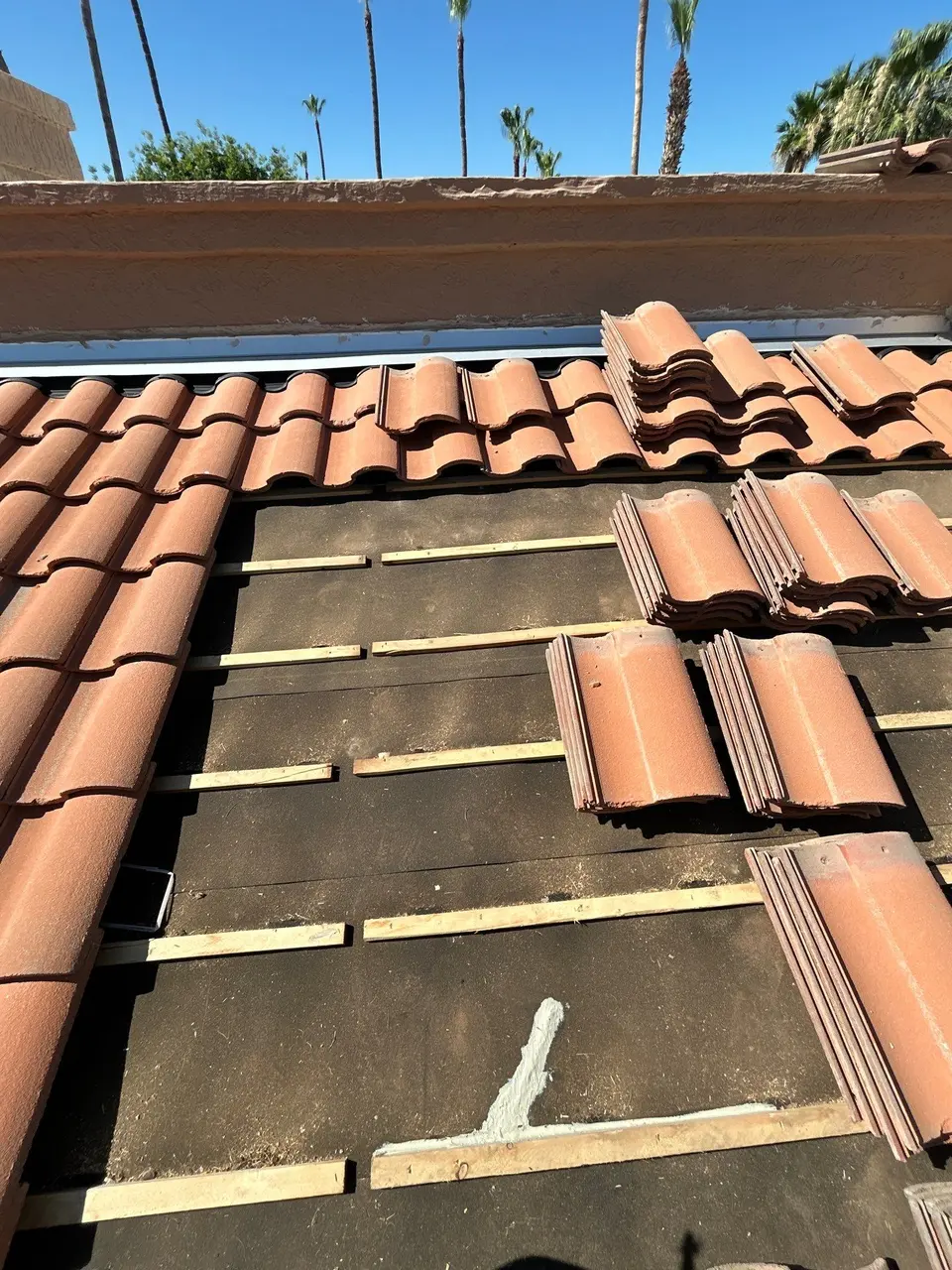
The short answer: for an Arizona tile roof, a high-temperature peel-and-stick membrane at the vulnerable areas over a high-temperature synthetic in the field is the combination that holds up best. The number that predicts performance here is the sustained-temperature rating, not the word “synthetic” on the proposal. Anything rated below 250°F sustained is the wrong product for this climate.
When a homeowner asks us which underlayment is best, they are usually holding two proposals that both say the word “synthetic” and cost different amounts. That single word covers products that will behave nothing alike on a Phoenix roof, which is the whole problem with shopping this line item.
Here is our short answer, and then the reasoning behind it. For a tile roof in the Valley, the best system is almost always a self-adhered SBS membrane in the places water actually attacks, paired with either a second ply or a genuinely high-temperature synthetic across the field. Straight 30-pound felt is the budget floor and it behaves like one. A cheap synthetic is felt with better marketing.
The Three Families, and What They Actually Are
If you want the background on what underlayment does and why the tiles are not the waterproofing, we covered that in our piece on why Phoenix tile roofs leak while the tiles look fine. This is about the material itself.
Asphalt-saturated felt. A mat of cellulose or fiberglass soaked in asphalt, sold as 15-pound and 30-pound and manufactured to ASTM D226 or D4869. This is what went down on most Valley tile roofs from the 1980s through the mid-2000s. Older Arizona installs often paired 30-pound felt with a 90-pound mineral-surfaced cap sheet, a two-ply system that was decent for its era and still turns up when we strip a roof in Sun City or Scottsdale. Felt is fine material. It is just organic asphalt with nothing modifying it, and sustained heat is what organic asphalt is worst at.
Synthetic. Woven or spun polypropylene or polyethylene, usually with a coated surface. Lighter, far stronger in tear resistance, will not wrinkle when damp, and safer to walk. The category is enormous and loosely defined compared to felt, and that is the trap. Two rolls on the same supply-house shelf can be rated for wildly different sustained temperatures, and nothing on the outside of the roll tells a homeowner which is which.
Self-adhered SBS modified bitumen. Asphalt modified with styrene-butadiene-styrene, a synthetic rubber, on a peel-and-stick backing, manufactured to ASTM D1970. The SBS is the part that matters: rubber modifiers keep the asphalt flexible across a much wider temperature range, so the membrane takes the daily expansion cycle without going stiff. You will also see APP-modified products, which use a plastic modifier and run a higher softening point with less elasticity. In tile work here, SBS dominates for good reason.
Why the National Ranking Does Not Survive the Drive to Phoenix
Most underlayment comparisons are written around water: which product sheds rain best, which survives being left exposed through a wet spring, which resists ice damming. Rank the three families on those questions and synthetic usually wins outright.
Rank them on sustained heat and the order changes.
A tile roof is a hot box. The tiles absorb sun all afternoon and radiate it downward into a dead air space, and the underlayment sits in that space near 140 to 170 degrees through a July afternoon, four months a year, cooling overnight and doing it again. Straight asphalt responds by giving up its oils until the mat underneath is dry and brittle.
SBS survives that because the rubber modifier is doing structural work, keeping the asphalt elastic as it ages. A quality high-temp synthetic survives because polypropylene is not asphalt and has nothing to bake out. A budget synthetic fails because its coating and binder were never engineered for four Phoenix summers, and once brittle it cracks at every fastener the same way felt does.
This is why the spec that actually matters on a synthetic is its sustained temperature rating, not the word “synthetic” and not the tear strength number on the wrapper. You want a product rated for continuous service above 250 degrees. Plenty are. Plenty are not, and the ones that are not get sold into tile jobs here constantly because the roll costs less and the homeowner has no way to tell.
The Fastener Hole Problem Nobody Mentions
Felt and synthetic are both mechanically fastened. Cap nails, thousands of them, each one a hole punched through your waterproofing layer.
On a steep roof in a rainy climate that is solved, because gravity moves water off before it finds a nail. Phoenix breaks both halves of that. Much of the Valley’s tract housing carries tile at 3:12 or 4:12, so water crosses the roof slowly. And our rain does not fall straight down. It arrives sideways at 50 or 60 miles an hour on a monsoon outflow, pushing water up under the tile laps against the slope, a mechanism we covered in our post on monsoon wind-driven rain.
Put those together and you get water moving uphill across a shallow surface studded with fastener holes, during exactly the storms when the underlayment has to work. A self-adhered membrane changes the math: it bonds to the deck across its whole face and seals around the fasteners driven through it. When we find leaks on a roof whose underlayment is not otherwise at end of life, the entry point is very often a fastener, a lap, or a penetration rather than the field of the membrane.
Your Roof Slope Decides More Than the Brand Does
Before you compare products, find out your pitch, because the code answer changes at 4:12.
The model residential code the Valley builds to splits tile roofs there. At 4:12 and steeper, a single layer of underlayment is the minimum. Below 4:12, down to the 2.5:12 floor where tile is permitted at all, it wants two. That is not an arbitrary line. On a low-slope tile roof the underlayment stops being a backup and becomes the primary water barrier, with the tile working mostly as a sun shade and a wind screen.
So if your house sits at 3:12, as a great many 1990s and 2000s Valley subdivisions do, a single-layer proposal is not a value engineering choice you get to weigh. Two layers, or one self-adhered membrane approved by its manufacturer as a single-layer tile underlayment, is the floor. Anyone quoting one ply of cheap synthetic on a 3:12 tile roof has told you something useful about how they work.
Battens, Direct-to-Deck, and Where the Water Sits
There is a second variable that changes how long any of these last, and it does not appear on most proposals.
Tile can be set directly on the underlayment or on wood battens that lift it off the deck. Battens are common here and they do good things: an air gap, a consistent course line, solid attachment. But a batten laid flat and continuous across the slope is a dam. Water running down the underlayment hits it and sits there, against the membrane, until it finds a way around. On a shallow roof that can be a long time.
The fix is elevated or notched battens, or counter-battens run vertically under the horizontal ones, so water has a path. That detail matters as much to a twenty-year outcome as which roll came off the truck, and it is worth asking about when you compare bids for a remove and reset.
What We Specify and Why
For most Valley tile roofs, we want a self-adhered SBS membrane carrying the areas that fail first: valleys, eaves, rakes, headwalls and sidewalls, and every penetration. Those are the places water concentrates, where flashing meets membrane, and where wind-driven rain gets pushed hardest. Then a high-temperature product across the field, either a second ply or a synthetic that genuinely carries the temperature rating.
Full self-adhered coverage across the whole deck is the strongest system we install, and on a low-slope roof, or a house the owner has no intention of leaving, it is the one we point at. It costs more and takes more labor to install correctly in summer heat, and the honest tradeoff is that the field of a tile roof is not usually where things go wrong first. The concentrated approach puts the best material where the water actually is.
What we will not do is put single-ply budget synthetic under tile in this climate. The tiles are going to last 40 to 100 years. Making the layer underneath them a fifteen-year part means somebody, probably you, pays to take every tile off the house twice instead of once. The underlayment replacement is the expensive event in a tile roof’s life, and material choice is most of what decides how often it comes around.
How to Read the Underlayment Line on a Proposal
Five questions separate a real spec from a word.
What is the brand and product name? Not “synthetic,” not “peel and stick.” A manufacturer and a model. If a contractor cannot produce that, they have not decided yet, which means the crew will use whatever is on the truck.
What is its sustained temperature rating? Above 250 degrees for continuous service. This is on the data sheet and it is the single most predictive number for Arizona.
Which ASTM standard does it meet? D1970 for self-adhered, D226 or D4869 for felt, D6757 for fiberglass-reinforced. It tells you the product was tested against something.
How many layers, and where does the self-adhered go? Get the boundaries in writing: valleys, eaves, penetrations, walls. “Peel and stick in critical areas” without a list of the areas is not a spec.
What is the manufacturer’s warranty on the material? Product warranties on quality high-temp membranes commonly run 25 years or longer. A short manufacturer warranty on the material is the manufacturer telling you what they expect.
Frequently Asked Questions
Is synthetic underlayment better than felt for an Arizona tile roof?
A high-temperature synthetic is meaningfully better, on the order of ten to twenty extra years. A budget synthetic is not reliably better than 30-pound felt here, and it is sold as though it were. The category name tells you nothing on its own, so the temperature rating on the data sheet is the thing to check.
What is the longest-lasting tile roof underlayment in Phoenix?
A quality self-adhered SBS membrane, which can run 30 to 50 years or more in our climate against 15 to 20 for standard felt. It seals around fasteners, bonds to the deck, and stays flexible through the daily heat cycle instead of going brittle. For a fuller breakdown of what moves those numbers on a specific house, see our post on how long tile roof underlayment lasts in Arizona.
Do I need two layers of underlayment under tile?
If your roof is below a 4:12 pitch, effectively yes, that is the code minimum. At 4:12 and steeper one layer meets code, though two layers or full self-adhered coverage buys real longevity in this climate. Find out your pitch before you compare proposals, since it changes which bids are even comparable.
Can I just replace the underlayment and keep my tiles?
Usually, and that is the good news about tile in Arizona. Concrete tile lasts 40 to 75 years and clay goes longer, so when the membrane is done the tiles generally are not. They come off, get stacked, and go back on over the new underlayment, with some breakage replaced from salvage or matched stock.
Does better underlayment matter if my tiles are old?
It matters more. The membrane is the part with the short clock, so upgrading it while the tiles are already off is the cheapest chance you will get. Moving from felt to a high-temp or self-adhered system during a remove and reset is a small share of the job and can be the difference between doing this once and doing it twice.
Find Out What Is Actually Up There
If you are weighing proposals, or just want to know what your builder put down twenty years ago, we will lift tiles in the spots that tell the truth, show you photos of what is underneath, and walk you through what your slope actually needs. Call Pinnacle Roofing at (623) 792-5497 for a free inspection and an honest read.