
TILE ROOFING
Repair, Restore, or Replace Your Phoenix Tile Roof?
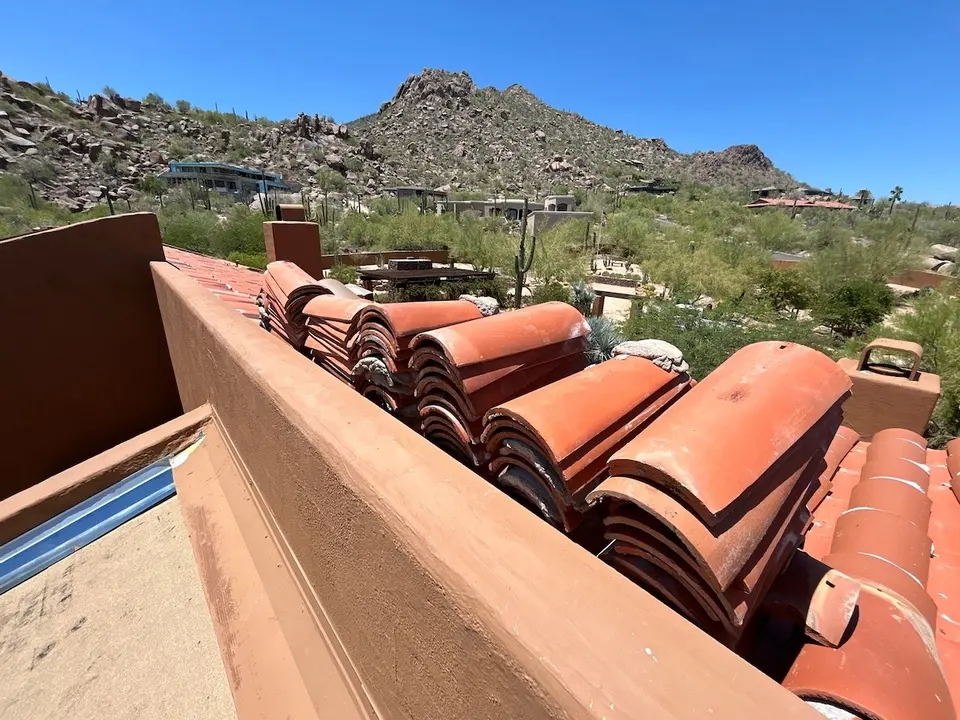
The short answer: if the underlayment still has years left and the leak is in one spot, repair it. If the tile is sound but the underlayment underneath is at the end of its life, restore the roof by pulling the tile, replacing the membrane, and setting the same tile back down. Full replacement is for roofs where the deck, the tile itself, or the structure has failed, which is less often than it gets proposed.
Should I Repair, Restore, or Replace My Tile Roof?
Almost every homeowner who calls us about a tile roof is really asking this, even when the words coming out are “I have a leak in the hallway.” They have one proposal for a repair and one for a whole new roof, the numbers are nowhere near each other, and there is no obvious way to tell whether the expensive one is thorough or opportunistic. The honest answer is that there are three options, not two, and the middle one is what most Valley tile roofs actually need.
The One Thing That Makes Tile Different in Phoenix
On a shingle roof, the shingles are the waterproofing. When they go, the roof goes, and repair-or-replace is a genuine two-way question.
Tile does not work that way. The tile is a sun shade and a wind screen. The waterproofing is the underlayment sitting on the deck underneath it, and those two layers have completely different clocks. Concrete tile in the Valley runs roughly 25 to 30 years and clay commonly goes past 50. The underlayment beneath it typically gives out around 20 to 25 years, because it spends four months a year baking in a dead air space that sits between 140 and 170 degrees under an afternoon sun, then cools overnight and does it again.
So the normal end state of a Phoenix tile roof is not a worn-out roof. It is a perfectly good set of tiles sitting on a dead membrane. That is exactly the situation the middle option exists for, and it is why “you need a new roof” is so often the wrong description of the problem. We laid out the age math in detail in our post on how long tile roof underlayment lasts in Arizona if you want to work out where your house sits on that clock.
Option One: Repair
A repair is the right call when the failure is local and the rest of the system still has life in it.
That looks like a cracked or slipped tile from someone walking the roof wrong, a failed pipe boot, a valley that was detailed badly at install, flashing pulling away from a wall, or a single wind-lifted section after a monsoon cell. One stain on one ceiling, in one place, on a roof that is fifteen years old, is usually a repair.
What we do before quoting one is lift tile in the area and look at the membrane. That is the whole test. If the underlayment around the failure is still flexible and intact, a repair is real work that buys real years. If it tears in our hands or crumbles at the fastener holes, patching that one spot just moves the next leak somewhere else on the same roof, and we will tell you so rather than sell you a repair we expect to fail.
Ask any contractor proposing a tile roof repair how the underlayment looked and how long they expect the fix to hold. A roofer who actually inspected it can answer both.
Option Two: Restore, Also Called a Remove and Reset
This is the option that gets left off most proposals, and it is the one that fits the largest number of Valley homes.
The crew takes the tile off the roof and stacks it, strips the old underlayment, inspects and repairs the deck, installs a new membrane built for Arizona heat, rebuilds the flashings and penetrations, and then sets your same tile back down. Broken and cracked pieces get swapped out from salvage or matched stock. When it is done you have a roof with a fresh waterproofing layer under tile that still has decades in it, and from the street the house looks exactly the same.
The reason this works is the material asymmetry above. You are replacing the fifteen to twenty-five year part and keeping the fifty year part. Doing it any other way means throwing away serviceable tile.
Restoration is the answer when your underlayment is at or near end of life, whether that shows up as leaks in more than one area, staining that reappears in different rooms after different storms, or simply an original roof on a house built in the 1990s or 2000s that has never been touched. It is also the moment to fix what the original builder did cheaply: this is the only affordable opportunity you will get to upgrade the membrane, and going from felt to a high-temperature or self-adhered system is a small share of the job. Our post on the best underlayment for a tile roof in Arizona covers which products actually survive here.
There are two versions worth knowing by name, because contractors use them loosely. A remove and reset is the full roof. An underlayment replacement may be scoped to a section, such as one slope or one elevation that failed first. Sectional work is legitimate when the rest of the roof genuinely has life left, and it is a way to stage the expense. It is not legitimate when it is being used to make a bid look smaller than the roof requires.
Option Three: Replace
Full replacement means new tile, not just new membrane, and it is the right answer in a narrower set of cases than it gets recommended in.
You are looking at replacement when the tile itself has failed, which shows up as widespread cracking and spalling across the field rather than a dozen broken pieces, or as concrete tile that has gone soft and porous with age. It is also replacement when there is not enough sound tile left to reset and no match available, when the deck or structure has real damage from a long-running leak, or when you are deliberately changing systems, for example moving a low-slope section off tile entirely.
Two honest notes. Tile breakage during any remove and reset is normal, not a sign something went wrong, and every proposal should say how breakage is handled and where replacement tile comes from. And a roof can need full tile replacement on one elevation while the rest of the house only needs a reset. Good proposals split that out.
The Five Things That Actually Decide It
When we walk a roof, this is what we are answering.
How old is the underlayment, not the house? If the roof has been redone since the build, the clock started then. If nobody knows, the build year is the working number until we lift tile and look.
How many failures, and are they related? One leak in one place points at a detail. Leaks in different areas after different storms point at the membrane.
What condition is the tile in? Sound tile makes restoration possible. Field-wide cracking and spalling is what pushes a roof into replacement.
What is under the tile at the deck? Soft or delaminated sheathing changes the scope no matter which option you pick, and it is the reason nobody can quote a tile roof honestly without getting on it.
How long are you staying? This is a legitimate input, not a sales question. A homeowner with two years left in the house and a roof at year eighteen has different math than one who intends to stay twenty.
One more variable that matters here more than most places: your pitch. A lot of Valley tract housing carries tile at 3:12 or 4:12, and on a low-slope tile roof the underlayment is doing nearly all the work, especially during monsoon storms that drive rain sideways up under the tile laps. We covered that mechanism in our post on monsoon wind-driven rain. Shallow roofs are less forgiving of a tired membrane and less suited to indefinite patching.
When Somebody Offers to Coat or Foam Over Your Tile
This comes up in Phoenix, usually after a storm, usually from someone who knocked. The pitch is that a coating or a layer of foam over the existing roof will stop the leaks without the labor of pulling tile.
Be careful with it. Sealing the surface does not repair a membrane that has gone brittle under the tile, and it can trap moisture in a deck that is already wet. There are legitimate uses for foam and coatings on flat and low-slope sections, and we install both, but as a way to avoid replacing dead tile underlayment it buys quiet rather than a fix. Ask anyone proposing it to show you photos of the underlayment they intend to cover.
What a Proposal Should Show You
Whatever option a contractor lands on, the paperwork should make the reasoning visible.
Photos from under the tile, not just from the ridge. The specific underlayment brand and product going down, not the word “synthetic.” A stated approach to deck repair, including what happens if they find bad sheathing after tear-off. How broken tile is counted and sourced. Flashing and penetration work listed as line items rather than assumed. And a license number you can check: run it through the Arizona ROC’s public license search before you sign anything. Ours is AZ ROC #161685, and we have been doing this in the Valley since 1999.
If two proposals recommend different options, that is not automatically a scam. It usually means one of them lifted tile and the other did not.
Frequently Asked Questions
Can you replace tile roof underlayment without replacing the tile?
Yes, and in Phoenix that is the standard job. The tile comes off, gets stacked, the new membrane goes down, and the same tile goes back on with broken pieces swapped out. It is the whole reason tile makes sense in this climate.
How do I know if my tile roof needs repair or full replacement?
The tile tells you. If the tiles are sound and the leaks trace to a failing membrane or a bad detail, you are choosing between repair and restoration. Widespread cracking, spalling, or soft concrete tile across the field is what moves a roof to full replacement.
Is it worth repairing a 20-year-old tile roof in Arizona?
Sometimes, and it depends entirely on the underlayment rather than the calendar. At twenty years an original membrane is near the end of its expected life here, so a repair may hold for a while or may just relocate the problem. Have someone lift tile and look before deciding, because that inspection is the difference between an informed repair and a guess.
Does a remove and reset extend a tile roof’s life?
It resets the waterproofing layer, which is the part with the short clock. With a high-temperature or self-adhered membrane, a properly done reset gives you decades on tile you already own.
Why does my tile roof leak when the tiles look perfect?
Because the tiles were never the waterproofing. Water gets past them by design, and the underlayment carries it back off the roof. When that layer goes brittle, the roof leaks while looking pristine from the driveway. We wrote about that failure pattern in why Phoenix tile roofs leak while the tiles look fine.
Find Out Which One Your Roof Needs
You cannot answer this from the ground, and neither can a contractor. If you want to know which of the three your house actually needs, we will get on the roof, lift tile in the places that tell the truth, show you photos of what is underneath, and give you a straight recommendation with the reasoning attached. Call Pinnacle Roofing at (623) 792-5497 for a free inspection.