
FOAM ROOFING
Is Foam Roofing Right for Your Phoenix Home?
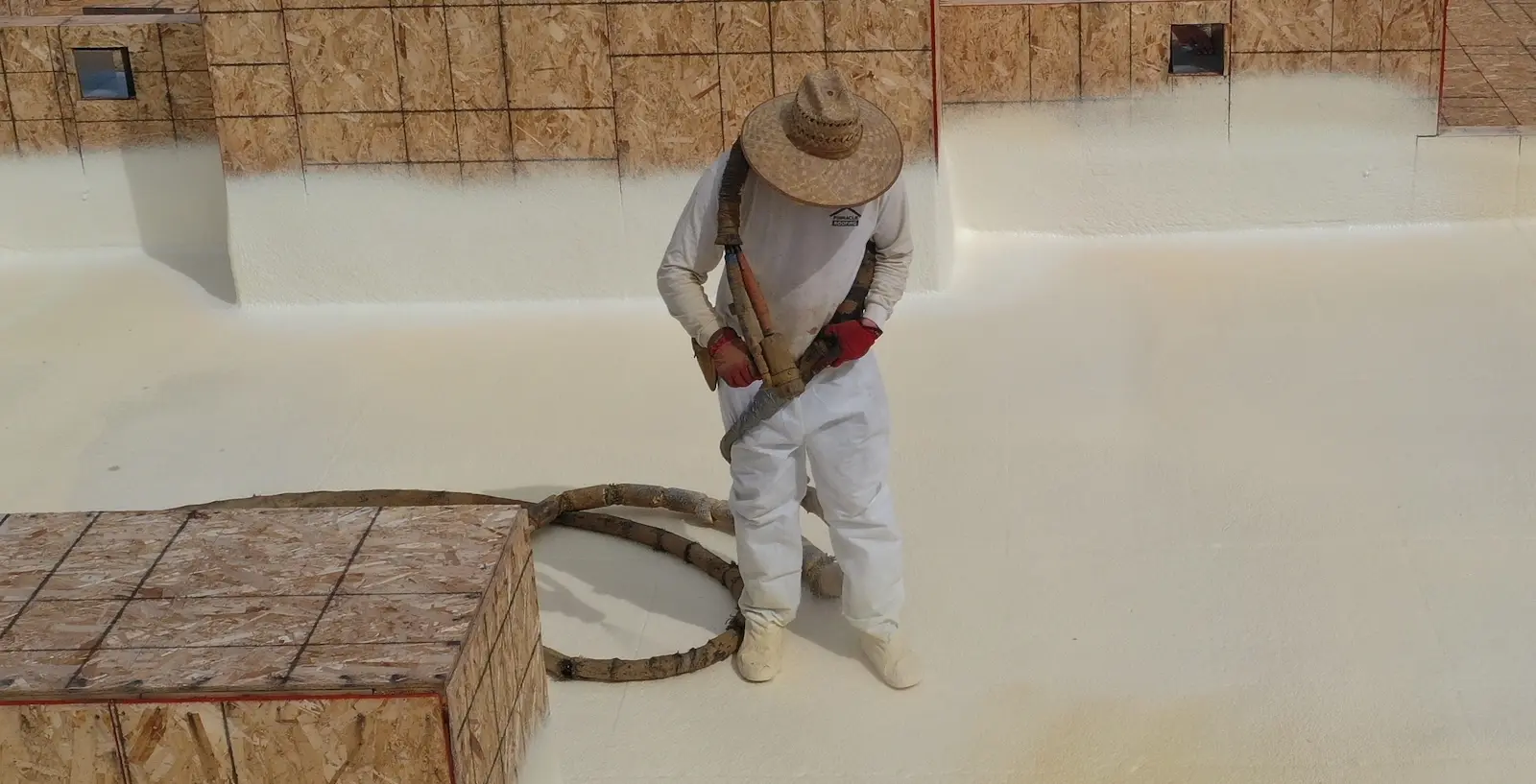
The short answer: on a flat or low-slope Phoenix roof, foam is usually the best system available, because it is seamless, it insulates, and it can be built up to fix drainage. The catch is that it is a maintenance system. Foam only works if you recoat it on schedule, and if that commitment is not realistic for you, a different system probably is.
Why the Valley Uses Foam When Most of the Country Does Not
Sprayed polyurethane foam is a specialty product in most of America and close to a default here. That is not a regional quirk, it follows from how houses in the Valley are built and what our weather does.
A large share of Phoenix housing has flat or nearly flat roof area. Desert-modern architecture, ranch homes with Arizona rooms, additions, carports, and almost every mid-century block house in the older parts of town. Flat roofs are a solved problem in dry climates and a chronic one in wet ones, and we are about as dry as it gets.
Foam suits that combination unusually well. It goes down as a liquid and cures into a single continuous surface with no seams, and seams are where flat roofs leak. It bonds directly to the substrate rather than being mechanically fastened, so there are no penetrations to work loose. And because it is sprayed to a thickness rather than rolled out at a fixed one, it can be built up in low spots to move water toward drains, which is the one thing no membrane can do.
What Foam Is Genuinely Good At
Seamless waterproofing. No laps, no fasteners, no field seams. On a roof with a lot of penetrations, curbs, and equipment, foam wraps all of it as one surface, which is exactly where other systems get complicated.
Insulation that the roof itself provides. Foam has real R-value, which most roofing does not. On a Valley house with an air handler and ducts in a hot attic or on the roof, that matters more than it sounds. It is the only common roofing material where the roof is also insulation.
Fixing drainage without rebuilding. Ponding is the number one flat roof complaint here, and foam is the only system that can be tapered on site to correct it. Slope can be built into the foam.
Light weight. Foam adds very little load, which makes it viable on structures that could never carry tile.
Recoverable. A foam roof that has been maintained does not need tear-off at end of life. You repair the damaged areas and recoat, which is why a well-kept foam roof can run decades without ever being fully replaced.
The Part Nobody Mentions Until Later
Foam is UV-sensitive. Left bare in Arizona sun it degrades, so the coating on top is not decoration, it is the only thing protecting the system. That coating wears out on a schedule, generally every 5 to 10 years here depending on whether it is acrylic or silicone, and it has to be renewed.
This is the real trade. A foam roof is not a system you install and forget for 30 years. It is a system that lasts a very long time on the condition that somebody keeps recoating it, and that stops being true the moment an owner decides to skip a cycle. We cover the timing in our post on the foam roof recoating schedule and the work itself in our post on recoating a flat roof.
If you are the kind of owner who keeps a maintenance calendar, foam is excellent and probably the cheapest roof you will ever own on a per-year basis. If you know you will forget about it for twenty years, be honest about that when you choose, because a neglected foam roof gets expensive.
The Other Honest Downsides
It damages underfoot. Foam dents and crushes under concentrated weight. On a roof that gets regular service traffic to HVAC equipment, walk pads matter, and a crew that drags a ladder across it will leave marks that need repair.
Birds. This one surprises people from out of state. Around here, birds do peck at foam, particularly on roofs where it is exposed or thinly coated. Keeping the coating intact is most of the answer.
Application quality is everything. Foam is mixed and cured on your roof, in real conditions, by the crew doing the work. Substrate temperature, humidity, wind, and the ratio coming out of the rig all affect whether you get good closed-cell foam or a soft, off-ratio batch that never performs. There is no factory quality control step. This is the system where the applicator matters most.
Weather windows. Foam cannot go down in wind, and it cannot go down wet. During monsoon season the schedule bends around the weather, which is normal here and worth expecting rather than being frustrated by.
Foam Against the Alternatives
Against single-ply, meaning TPO or PVC. Single-ply is a good product and the commercial default in much of the country. It is mechanically fastened or adhered in sheets, so it has seams, and it does not insulate or fix slope. It is often the better answer on a very large simple roof. Foam usually wins on a cut-up residential roof with a lot of penetrations.
Against modified bitumen or built-up roofing. These are what foam usually replaces on older Valley homes. They work, they are heavier, they have seams, and they do not insulate.
Against tile or shingle. Not a real comparison. Those are pitched-roof systems. If your roof has both flat and pitched sections, the normal answer is foam on the flat and tile, shingle, or metal on the pitch, and that combination is everywhere in the Valley.
Frequently Asked Questions
How long does a foam roof last in Phoenix?
The foam itself can last decades, effectively indefinitely if it is kept coated, since it never has to be torn off. What has a fixed lifespan is the coating on top, generally 5 to 10 years per cycle in our sun. People who say a foam roof lasts 20 years are usually describing a roof that got one recoat and was then forgotten.
Is foam roofing expensive?
It costs more than a simple membrane going down and less than most pitched-roof systems, and its real advantage is on the long horizon, since you are maintaining rather than replacing. What it costs on your roof depends on square footage, how much prep and tear-off is needed, and how much taper has to be built in for drainage.
Can foam go over my existing flat roof?
Often yes, which is part of the appeal, and it depends on what is there and whether it is dry. Wet insulation under an old roof has to come out first. Coating or foaming over trapped moisture is how a roof gets worse expensively.
Does foam roofing really lower cooling costs?
It does add insulation the roof did not have, and on a house where the flat roof sits directly over living space that is noticeable. We are not going to attach a number to it, because your insulation, ducts, and equipment matter at least as much as the roof does.
Can I walk on a foam roof?
Carefully, and it is better if you do not make a habit of it. Concentrated weight dents it. If there is equipment up there that gets serviced, ask about walk pads on the path to it.
Find Out What You Actually Have
Most people asking about foam either have it already and are not sure what shape it is in, or have a flat roof that keeps leaking and have been told foam is the answer. Both are answerable in one visit.
We will tell you what is up there now, whether it is dry, and whether foam is the right next move or not. Call Pinnacle Roofing at (623) 792-5497 for a free inspection, or read more about foam roofing.