
TILE ROOFING
Apartment Tile Roof Repair in Phoenix
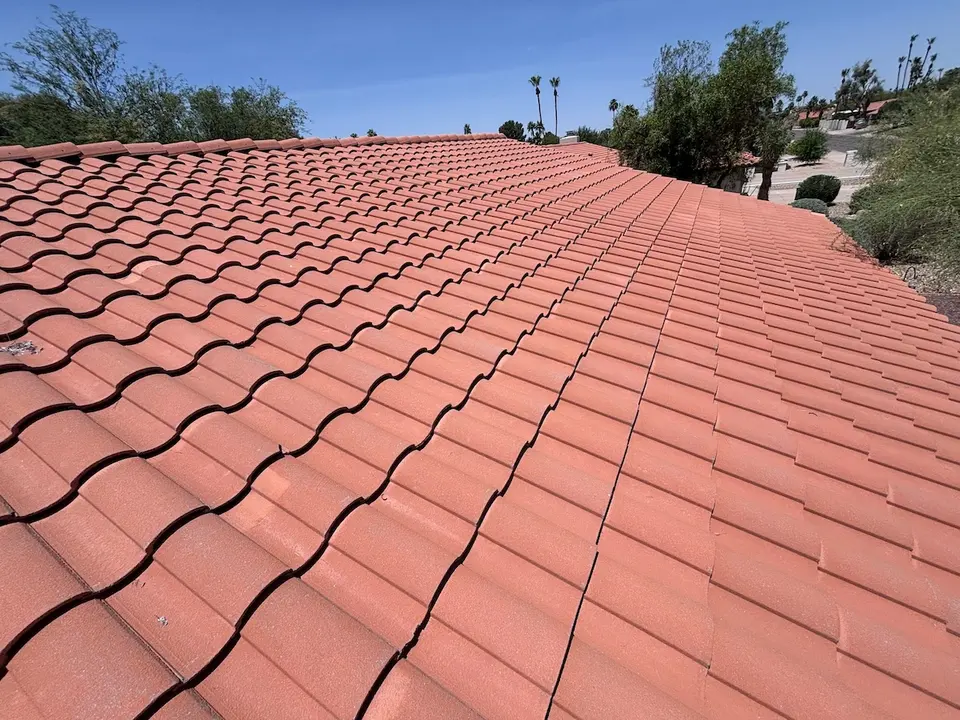
The short answer: on a Phoenix apartment property, individual tile repairs are worth doing while the underlayment still has life, and past a certain point they stop being economical. Most Valley multifamily built in the 1980s and 1990s is at or past that point now, and the useful planning question is not whether to reroof but how to phase it across buildings.
Why the Whole Vintage Is Failing at Once
Concrete tile went on an enormous amount of Valley multifamily during the building boom of the 1980s and 1990s, over 30-pound felt underlayment, which was standard practice at the time and correct for the era.
Felt in Phoenix heat runs roughly 15 to 20 years. That math has been up for a while on every one of those buildings.
The result is a pattern property managers know well: leak calls that were once a year become several a year, then a steady trickle, and each one is genuinely a separate leak rather than a recurrence of the same one. The tiles above still look fine, because concrete tile lasts many decades and has decades left. What is finished is the layer underneath, and it is finished across the whole property at roughly the same rate, because it all went on in the same year.
Understanding that changes the budget conversation from maintenance to capital planning.
What Repair Still Solves
Not every leak on an aging property means the building is due. Real repairs, worth doing on their own:
Broken tiles. Multifamily roofs get walked constantly. HVAC service, satellite and cable installs, pest control, and window and paint crews all end up on them, and concrete tile breaks under careless foot traffic. Each break exposes underlayment to direct sun, and that spot then ages far faster than the rest. Replacing broken tiles promptly is cheap and it genuinely extends the underlayment’s life.
Flashing and penetrations. Where the roof meets walls, chimneys, and equipment curbs. On buildings with rooftop mechanical this is where most leaks begin.
Valleys. Long roof runs on multifamily mean long valleys, and they collect debris. A blocked valley backs water up over the flashing.
Storm damage. Localized and often insurable, and worth documenting properly at the time.
If the underlayment across the rest of the roof is still sound, these repairs hold and are the right spend.
When Repair Stops Making Sense
The signal is frequency and distribution. When leak calls start coming from different buildings and different elevations rather than the same trouble spot, you are no longer fixing failures, you are chasing a system that has reached the end of its service life.
At that point the economics invert. Each repair costs real money, involves a unit turn or a resident inconvenience, and buys a few months before the next call from somewhere else. The cumulative spend over two or three years of that frequently exceeds the cost of doing the underlayment properly.
The good news for an owner is that the answer is rarely a full tile replacement. It is a remove and reset: the existing tile comes off and is stacked, the failed underlayment is replaced, damaged deck is repaired, and your own tile goes back on. You pay for labor and materials rather than for a property’s worth of new tile. Our post on repair, restore, or replace works through that decision in detail, and the underlayment lifespan post covers the age math.
Planning It Across an Occupied Property
The part that makes multifamily different from a house is not the roofing, it is everything around the roofing.
Phasing by building. Almost nobody does an entire property at once, and almost nobody should. Building-by-building phasing lets the work fund from reserves over multiple cycles and keeps disruption contained. Sequence by condition rather than by address, worst buildings first, and get a condition survey that ranks them so the order is defensible to an owner or a board.
Resident communication. Tile work is loud and it goes on for days per building. Residents need notice, and they need to know about parking, access, and when crews will and will not be working. Handled well this is a non-event. Handled poorly it generates more management workload than the roofing does.
Staging and access. Tile has to come off and go somewhere. On a tight property with covered parking and landscaped courtyards, where material stages is a real planning question, and it affects both cost and how many parking spaces disappear for how long.
Timing. Monsoon season constrains this work, since an open roof and an afternoon storm cell are a bad combination. The Valley’s mild fall through spring is the natural window for planned multifamily roofing, which means budget approval usually needs to land well before it.
Documentation. Owners and boards want photos and written condition reports, not verbal reassurance. That should be part of the scope from the start, and it makes the next phase easier to justify.
Covered Parking and Ancillary Structures
Worth flagging because it gets forgotten in budgets. Most Valley apartment properties have carports, covered walkways, laundry buildings, and leasing offices, and these usually have different roof systems from the residential buildings, often low-slope foam or membrane on a different maintenance cycle.
They fail on their own schedule and they are frequently left out of a roofing plan that was scoped from the residential buildings. Get them surveyed at the same time even if the work happens separately.
Frequently Asked Questions
Can you repair tile roofs on an occupied apartment building?
Yes, and most of the work we do on multifamily is on occupied properties. It requires more coordination than an empty building, mainly around notice, parking, and access, which is why the planning matters as much as the roofing.
How do we know whether to repair or plan a reroof?
A condition survey that includes lifting tile in multiple locations across multiple buildings, not a visual from the ground. The tiles looking fine is exactly the thing that is not in question. The survey should give you a building-by-building ranking you can budget from.
Do all the buildings have to be done at once?
No, and usually they should not be. Phasing by condition over several budget cycles is the normal approach and it keeps both cash flow and resident disruption manageable.
How long does one building take?
It depends on size, roof complexity, and how much deck repair turns up once the tile is off. What we can commit to is a written schedule per building before work starts, so notices to residents are accurate.
Is this an insurance claim or a capital expense?
Storm damage may be a claim. Underlayment reaching the end of its service life is a capital expense, not a covered loss, and it is worth being clear about that distinction early so the budget conversation is realistic.
Get a Property-Wide Condition Survey
The most useful thing for a property manager is not a repair quote, it is a ranked picture of every building so the next three years can be planned rather than reacted to.
We will survey the property, lift tile where it matters, and give you a written building-by-building assessment. Call Pinnacle Roofing at (623) 792-5497, or read more about our apartment roofing work.