
METAL ROOFING
Does a Metal Roof Make Your Phoenix Home Hotter?
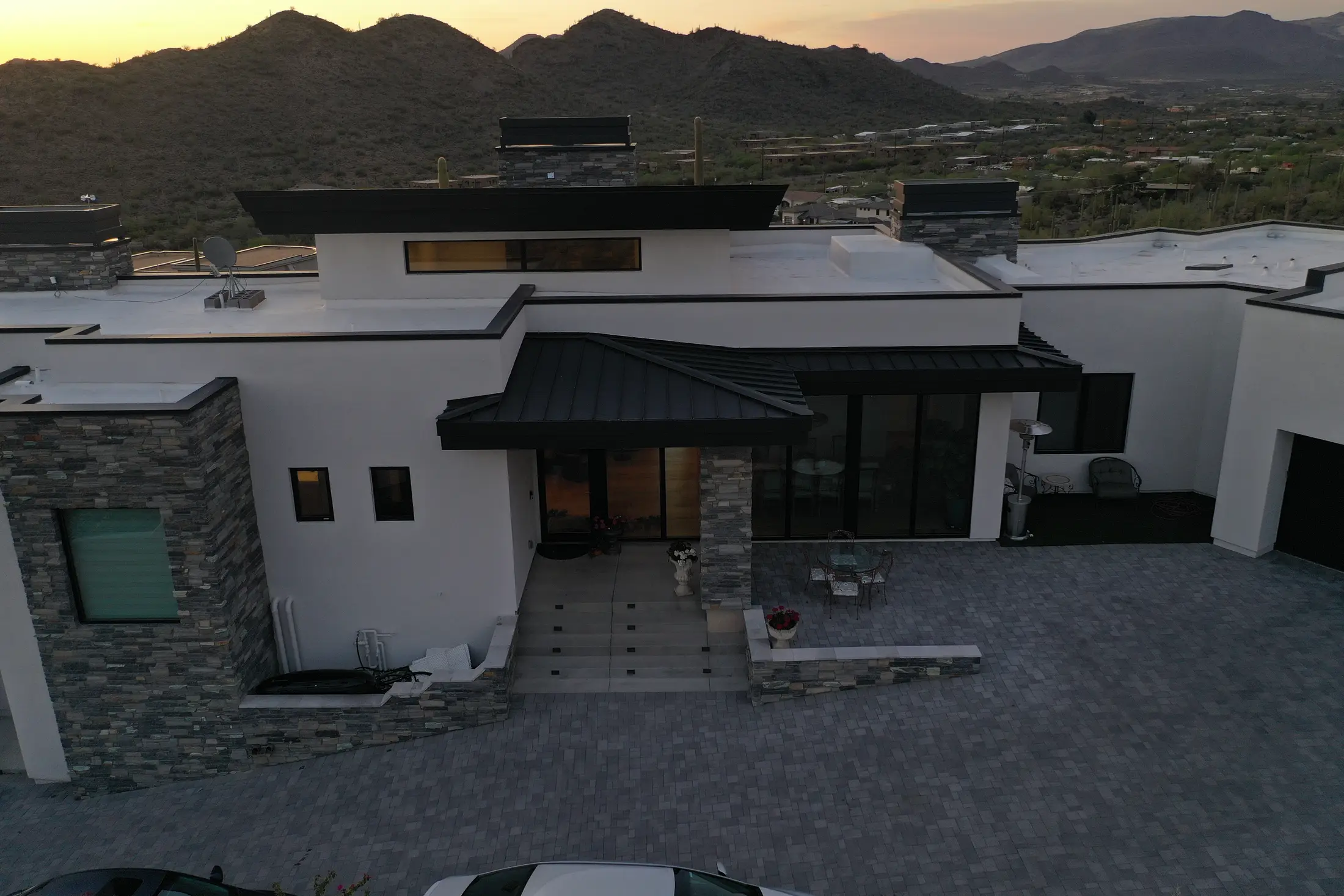
The short answer: no. A metal roof gets hot to the touch, the same as every other surface in Phoenix in July, but it holds almost no heat, so it stops sending warmth into your attic within minutes of losing the sun. Tile and shingles keep doing it for hours. Whether that shows up on your power bill is a separate question, and the honest answer there is less dramatic than most roofing sites will tell you.
Does a metal roof make a house hotter in Arizona?
It is the question we get more than any other on metal, and the instinct behind it is completely reasonable. Touch a car hood in a Costco lot in July. Metal in Arizona sun is genuinely brutal to be near, so a whole roof of it sounds like a bad idea.
The instinct is measuring the wrong thing. How hot a surface feels tells you its temperature at that instant. What determines your indoor comfort is how much of that heat makes it through the roof assembly and into the space where your ducts and your bedrooms are, and how long the roof keeps delivering it after the sun moves off.
On both of those, metal does well. Not because it stays cool, because it does not, but because of what it fails to do: store heat.
The Thing Nobody Mentions: Thermal Mass
Here is the mechanism that matters most in the Valley, and it is the one generic roofing articles skip in favor of reflectivity charts.
A concrete roof tile is a heavy, dense object. It weighs somewhere in the range of nine to twelve pounds per square foot, and it spends the entire day absorbing energy. A steel or aluminum roof panel is a couple hundredths of an inch thick and weighs on the order of a pound or so per square foot. It has almost nothing in it to store energy with.
Think of a frying pan versus a cast iron skillet. Both get scorching on the burner. Pull them off and the thin pan is safe to touch in a couple of minutes while the cast iron is still dangerous half an hour later. Your roof works the same way.
That is why the discomfort pattern in a Valley tile home is what it is. Ask somebody with a tile roof when the upstairs feels worst, and they will not say two in the afternoon. They say seven or eight in the evening, after sundown, when the outside air has finally dropped and the house has not. That is stored heat leaving the tile and the deck the only direction it can go, which is down. A metal roof stops radiating almost as soon as the sun angle changes.
Reflectivity gets all the marketing attention. Thermal mass is what you actually feel at nine at night in July.
Your Attic Is Where the Real Damage Happens
This is the part of the conversation that is specific to how houses get built here, and it is the reason roof heat is worth caring about at all.
In most of the Valley, the air handler and the duct runs live in the attic. Not in a conditioned basement, because we do not have basements. Your cold air is manufactured and then piped through the hottest part of your house.
Under a dark shingle or tile roof on a 115 degree afternoon, the space right under the deck is running far above ambient, and we have measured well over 180 degrees under tile on the worst days. Every foot of duct in that attic is losing capacity, every small leak in the duct system is dumping conditioned air into an oven, and your system runs longer to make up the difference. That is the real cost of a hot roof in Phoenix, and it is not really about the roof surface at all. It is about what the roof does to the room your air conditioning lives in.
Anything that lowers attic temperature helps that. A lower-mass, more reflective roof is one lever. So is attic insulation depth, and so is sealing the ducts, and on many tract houses those two are the bigger lever. We would rather say that plainly than pretend a roof choice fixes a duct problem.
Where Metal’s Advantage Is Real, and Where It Is Small
Honest version, by what you have now.
Replacing dark asphalt shingles. This is where the difference is most noticeable. Dark shingles absorb nearly everything that hits them, they hold moderate heat, they sit directly on the deck with no air gap, and they lose what reflectivity they had as they weather in our UV. Metal beats them on every one of those. If your upstairs has always been hot and you are on old dark shingles, you will likely feel a change.
Replacing tile. Smaller than you would guess, and this surprises people. Tile is heavy and stores heat, which is the knock on it, but tile also sits up on battens or on its own curvature with an air gap underneath, and that gap does real work. You gain on the evening heat discharge. You do not gain nearly as much at peak. Anyone promising a dramatic difference on a tile-to-metal swap is selling.
A new build or an addition. Free choice, no incumbent, and metal is a strong answer, particularly with a light or mid-tone color.
The other thing worth knowing is that color is less limiting than it used to be. Coil finishes made for hot climates use pigments that reflect in the infrared range, so a bronze or charcoal panel rejects meaningfully more heat than a dark shingle in the same color family. That matters here because plenty of Valley HOAs specify earth tones. You do not have to choose between a white roof and an approvable one. A lighter color still performs better, so if the choice is open, take the lighter one.
Above-Sheathing Ventilation
One more mechanism, because it is the piece most people have never heard of and it is worth asking your contractor about.
When metal panels are set on battens or on elevated clips instead of flat on the deck, an air channel forms between the panel and the sheathing. Hot air rises through that channel and exits at the ridge, carrying heat off the assembly before it can conduct down into the deck. It is the same principle that makes tile perform better than its weight suggests, applied to a system that also has low mass and better reflectance.
Not every metal roof gets it. It depends on the system and how it is installed, and it is a legitimate question to put to anyone quoting you standing seam. Ask whether their assembly has a ventilation gap and how it vents.
So Will It Lower My Power Bill?
Something, probably, if you are coming off dark shingles. We are not going to put a number on it, and we would be suspicious of anyone who does.
The reason is that your roof is one input among many. Two identical houses on the same street with the same new metal roof will have different bills, because one has R-38 in the attic and tight ducts and sun screens, and the other has settled insulation, a twenty-year-old air handler, and west-facing glass with nothing on it. A roof cannot out-perform those. Any contractor who quotes you a specific monthly saving is producing a number they cannot support, and if they are willing to do that on the energy math, consider what else they are willing to do it on.
What we will say confidently: a metal roof will make your attic cooler than dark shingles did, it will stop dumping heat into the house in the evening the way tile does, and the comfort difference upstairs is the part homeowners tend to notice first. Treat any bill improvement as a bonus rather than the reason to do it. The better reasons to buy metal are that it lasts a long time and asks very little of you, which we get into in our post on how long a metal roof lasts in Arizona.
If cooling load is genuinely your main goal and you have a flat or low-slope roof, a white foam roof is the more direct tool. It is the highest-reflectance surface we install, and on the right building it does more for heat than a change of pitched roofing material would.
Frequently Asked Questions
Is a metal roof hotter than tile in Phoenix?
At peak sun, surface temperatures are in a similar range depending on color and finish. The difference shows up after the sun moves. Tile holds its heat and keeps releasing it into the attic through the evening. Metal sheds it almost immediately.
Does a metal roof make the house louder in rain?
Less than people expect. A residential metal roof is installed over solid decking and underlayment, not over open framing like a barn or a patio cover, and that assembly deadens most of it. It is a different sound from tile, but the drumming people imagine comes from uninsulated structures.
Will a light-colored metal roof look out of place on a desert home?
Not usually, and the palette is wider than most people realize. Desert tans, sandstone, weathered zinc, and light grays all read as appropriate here and perform better than dark colors. If your HOA restricts you to darker earth tones, a coil finish with infrared-reflective pigment gets you most of the way.
Do I need to add attic insulation if I put on a metal roof?
They are separate systems and both matter. The roof controls how much heat reaches the attic. The insulation controls how much of it gets from the attic into your living space. If your attic insulation is old or settled, adding to it is usually the cheaper of the two improvements, and doing both is what actually changes how the house feels.
Does metal work on a low-slope Phoenix roof?
It depends on the pitch and the panel system. Standing seam handles lower slopes than exposed-fastener panels, but there is a floor below which no metal panel belongs and a membrane or foam system is correct. Anyone bidding metal on a nearly flat roof should be able to tell you the minimum slope for the exact system they are proposing.
Come Look at It With Us
The most useful thing is usually not a chart. It is somebody in your attic with a thermometer telling you how hot it actually is up there, what your insulation looks like, and whether your roof is the thing to change first.
We will do that and tell you honestly if the answer is something other than a new roof. Call Pinnacle Roofing at (623) 792-5497 for a free inspection, or read more about metal roof replacement if you already know the direction you want to go.