
METAL ROOFING
How Long Does a Metal Roof Last in Arizona?
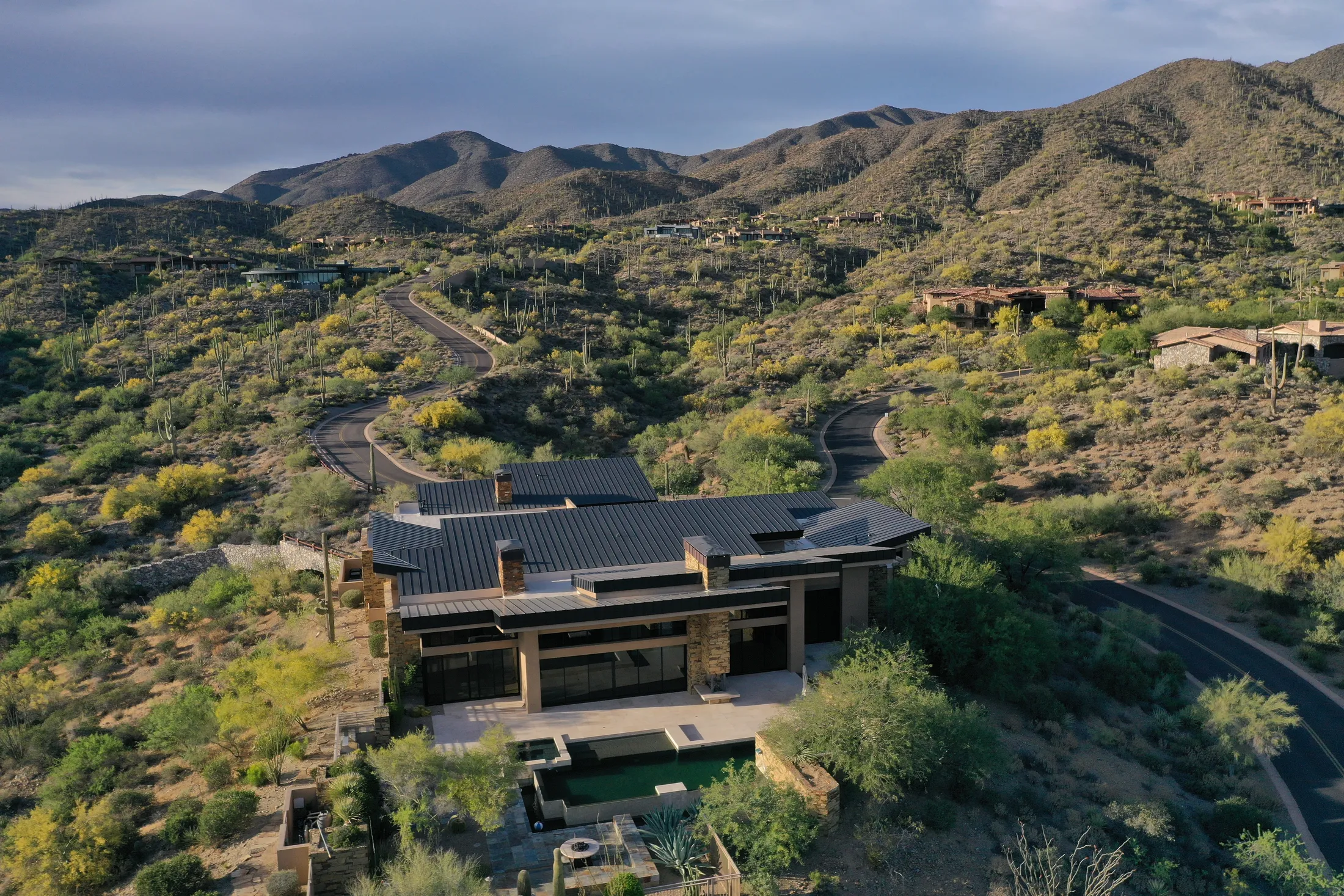
The short answer: a standing seam metal roof in Arizona commonly lasts 40 to 60 years, and an exposed-fastener corrugated roof runs closer to 25 to 40. In the Valley the panel itself almost never wears out first. What ends a metal roof early here is the small hardware around it: fastener gaskets, sealant at penetrations, and flashings that were never detailed for how far this metal moves between a January dawn and a July afternoon.
How long does a metal roof last in Arizona?
Those two ranges are the honest starting point, and the spread inside them is not marketing padding. It is the difference between a roof that got the details right and one that did not.
The number people usually quote is the panel’s number, and a coated steel or aluminum panel sitting in Phoenix sun is a remarkably stable thing. It does not rot, it does not curl, it does not lose granules, and our air is not doing much to it chemically. If the panel were the only variable, almost every metal roof in the Valley would hit the top of its range.
It is not the only variable. Every metal roof is a field of panels plus a few hundred fasteners, a dozen flashings, some sealant, and a handful of penetrations. The field lasts decades. The other parts are on their own clocks, and in this climate those clocks run faster. So the useful question is what fails first here, and how long that part takes to get there.
What Actually Ends a Metal Roof Early Here
Four things, in roughly the order we find them.
Exposed fastener gaskets. On a corrugated or R-panel roof, the screws go straight through the face of the metal, and a rubber washer under each screw head is the only thing sealing that hole. That washer is the shortest-lived component on the roof. UV and heat make it harden, shrink, and lose the compression that made it a seal, and since the hundreds of them on a roof all age at the same rate, they tend to let go as a group. Standing seam avoids this entirely by hiding its clips under the seam, which is most of why its range is higher.
Thermal movement, every single day. A dark metal panel can sit near 160 degrees on a July afternoon and drop into the 30s on a clear January morning, and it grows and shrinks with every cycle. A long panel run moves a real, measurable amount. Standing seam is built for that: the clips let the panel slide while the seam stays closed. An exposed-fastener roof is pinned at every screw and cannot slide, so the movement goes into the screw holes and slowly ovals them. That is why old corrugated roofs here end up with backed-out screws and enlarged holes that no amount of new sealant fixes.
The coating, on its own separate clock. The finish is what you look at and what protects the metal from UV. PVDF coatings, sold as Kynar 500 or Hylar, hold color and resist chalking through sustained exposure. Polyester finishes, usually labeled SMP, cost less and do fine in most of the country, but under 300-plus days of Arizona sun they chalk and fade sooner, saturated colors first. A chalked panel is not leaking. It just looks tired long before the roof is done, which matters when the roof is a visible design element on a desert home.
Sealant and flashing at the penetrations. Every vent, curb, wall termination, and valley. Sealant is a maintenance item everywhere, and here it is on a shorter interval because it is baking. Roofs that fail before their time usually failed at four or five specific spots, not across the field.
Notice what is not on that list.
The Corrosion Problem We Mostly Do Not Have
Most of what is written about metal roof lifespan online is written for climates that are hard on metal in ways Arizona is not: coastal salt air, months of standing humidity, freeze and thaw working the seams, ice damming, snow load, and long wet periods where a scratch in the coating turns into a rust streak. That is why national articles spend so much time on substrate and edge corrosion.
The Valley is close to the opposite. Our air is dry and effectively salt free, water sits on a roof for a few hours a few times a year, and nothing here freezes hard enough to work a seam open. Bare cut edges that would bleed rust in Florida within two seasons often sit here for years looking about the same. That is the reason metal is a strong long-term choice on a desert house.
There are two local exceptions worth knowing.
The first is evaporative coolers. Plenty of Valley homes still run one, and the bleed-off water is loaded with dissolved minerals. When that water discharges onto a metal roof or runs down a panel for years, it leaves mineral deposits that hold moisture against the finish and can eventually etch it. If you have a cooler on your roof, where its water goes matters more than almost anything else you can control.
The second is dissimilar metals. Copper, bare steel, or the wrong fasteners in contact with an aluminum panel will corrode at the contact point regardless of how dry the air is. It shows up at flashings and at repairs, where somebody used whatever screws were in the truck. It is an installation problem, not a climate problem, but we find it here as often as anywhere.
What Our Weather Does Do
Two Phoenix-specific things shorten a metal roof, and neither one is rust.
Monsoon rain does not fall down, it flies sideways at speed. On an exposed-fastener roof it finds end laps and any screw hole that has lost its washer, and it can push water uphill under a panel end. We covered that mechanism in our post on what monsoon wind-driven rain does to Phoenix roofs, and metal is not exempt from it.
Haboob dust is the other one. A dust storm is a sandblasting event, and while it will not strip a coating in one pass, decades of it is not nothing. The bigger practical issue is that fine dust packs into seams, valleys, and the low ends of panels, then gets wet, and holds moisture in a place designed to shed it fast. Clearing drainage paths after a big storm is most of the maintenance a metal roof needs here.
Roof-Mounted Equipment Is the Quiet One
Our packaged HVAC units sit on the roof, and somebody services them a couple of times a year. That means foot traffic on panels, ladders set on edges, and condensate lines dumping water wherever is convenient. Dents are cosmetic on a heavy-gauge panel and a real problem on a thin one, repeated traffic across the same path works fasteners loose, and condensate running somewhere that was never a drainage path is how a roof gets a stain and then a soft deck under it. If your metal roof has a unit on it, the path people walk to reach it is the first place we look during a roof inspection.
Gauge, Substrate, and the Specs That Move the Number
If you are choosing a metal roof now and want the long end of the range, four things do most of the work.
System type. Concealed-fastener standing seam versus exposed-fastener panels is the biggest fork in the road for lifespan, and we compare the two in depth in our post on standing seam versus corrugated metal roofing. Corrugated has real uses and a real cost advantage. It is not the answer if the goal is the longest service life with the least attention.
Gauge. Thinner steel dents more easily, oil-cans more visibly on wide faces, and holds a fastener less well over decades of movement. The Valley does get hail, not often, but it gets it. Heavier gauge is the least glamorous line on a metal roof proposal and one of the more durable ones.
Coating family. PVDF versus SMP, as above. On a house where the roof is visible from the street or from a hillside, this decides how it looks in year 20.
How the installer handled movement. Clip type and spacing, panel length, whether the panel is allowed to float, how end laps are made. Homeowners cannot see any of it and cannot inspect it later, which is why who installs a metal roof matters as much as what you buy. Verify the license of anyone bidding your roof through the AZ ROC, and see our guide on how to choose a roofing contractor for the rest.
Warranties Are Two Different Documents
Metal roofing warranties confuse people because there are usually two of them covering unrelated things. The paint or finish warranty comes from the coil manufacturer and covers chalk, fade, and film failure, so it is about appearance. The weathertightness warranty, where it exists, is about leaks and generally applies to commercial standing seam installed by a certified crew to the manufacturer’s details. Most residential metal roofs do not carry one and do not need one.
Neither document is the workmanship coverage from the company that installed your roof, which is the one that matters most in the early years. We back our own work with comprehensive warranties, and we would rather explain the difference up front than have somebody find it out later.
Frequently Asked Questions
Does a metal roof last longer than tile in Arizona?
It depends what you mean by the roof. A concrete or clay tile can outlive almost anything, but the underlayment beneath it is the waterproofing, and it needs replacing on its own schedule while the tile is still perfectly good. A metal roof is the waterproofing, so there is no hidden second layer running out ahead of it. That difference matters more than either headline number.
Do metal roofs get hit hard by monsoon storms?
A properly installed standing seam roof handles monsoon wind about as well as any residential system, because there are no exposed fasteners for wind-driven rain to work on. Exposed-fastener roofs get more vulnerable as they age, since the weak points are the screw holes and the end laps.
What maintenance does a metal roof need here?
Not much, and that is most of the appeal. Keep valleys and drainage paths clear, especially after dust storms. Have the penetrations and sealant looked at every few years. On an exposed-fastener roof, plan on the fasteners and washers being a scheduled item rather than a surprise. Anything found early is usually a metal roof repair rather than a section replacement.
Can a metal roof be repaired, or does the whole thing have to go?
Almost always repaired. Panels can be replaced individually and flashings reworked without touching the field, which makes metal one of the more repair-friendly systems out there. The exception is a roof where the screw holes have ovaled out across the whole surface, because at that point every hole is a future leak.
How can I tell how old my metal roof is?
If you do not have paperwork, the fasteners tell you a lot. Backed-out screws, cracked or flattened washers, and rust rings around screw heads mean an older exposed-fastener roof. On standing seam, look at the finish on the south and west slopes compared to the north: heavy chalking on one side and not the other is a coating that has been out there a long time.
Have a Look, or Have Us Look
If your metal roof is old enough that you are asking the question, the answer is usually visible in about ten minutes up there. We will tell you what system you have, what shape the fasteners and sealant are in, and whether you are looking at maintenance or replacement. Call Pinnacle Roofing at (623) 792-5497 for a free inspection.