
METAL ROOFING
Why Phoenix Wood Fascia Fails, and What Metal Fascia Does
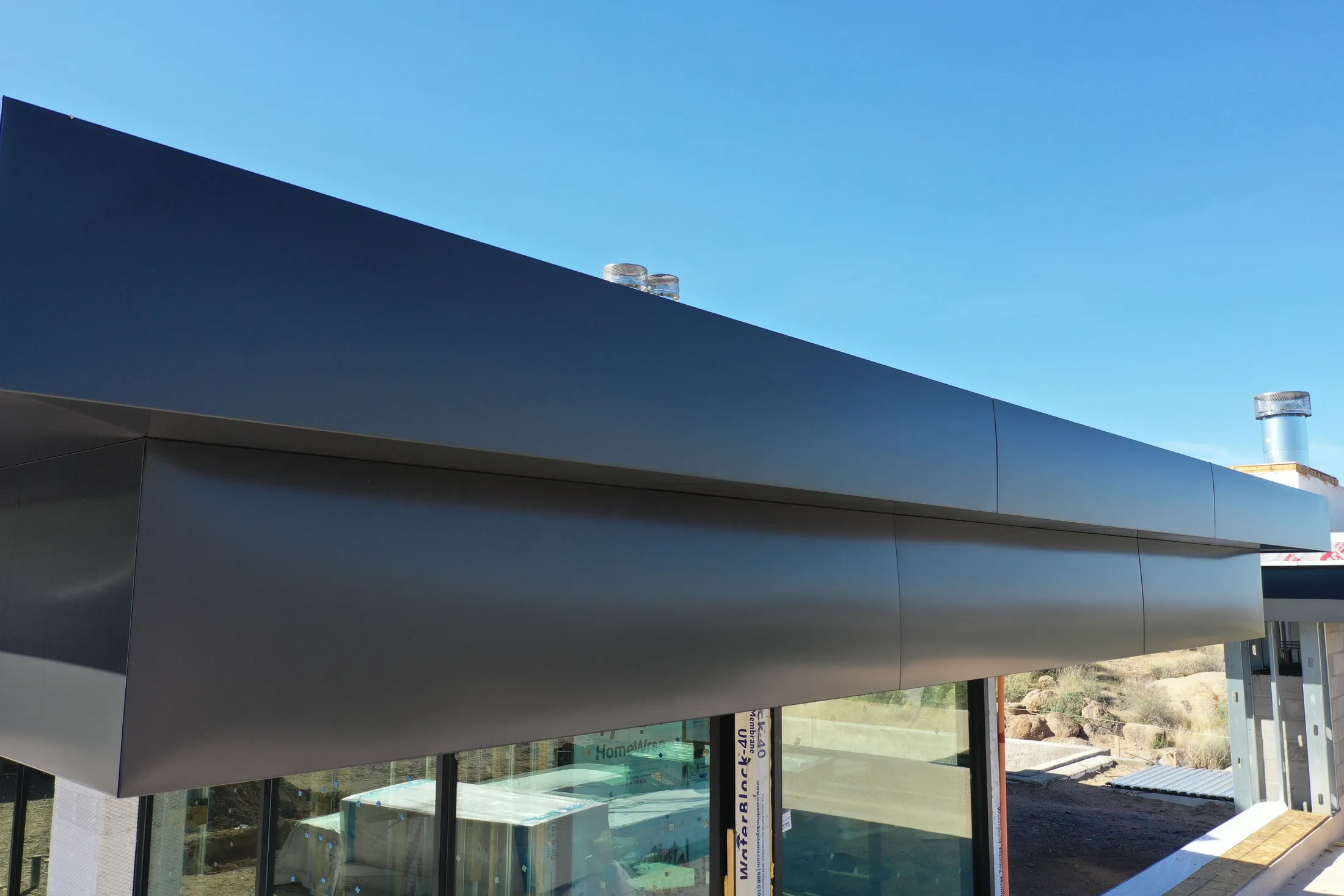
The short answer: wood fascia fails in Phoenix because it is the most sun-exposed board on the house and it gets wet from above every time it rains, so the paint film gives out first and the wood follows. Metal fascia is sheet aluminum or steel bent to your exact fascia profile and installed over sound boards, or over new boards where the old ones are gone. It ends the repaint cycle, because a factory finish does not peel in UV and metal does not rot.
Why does my fascia keep peeling and rotting?
Because in the Valley the fascia is doing a job nobody designed it for.
Fascia is the flat band running along the roof edge, closing off the ends of the rafters or truss tails. Gutters hang on it, the drip edge tucks behind it, and it is what your eye reads as the line of the roof. On paper it is trim. On a Phoenix house it is a long softwood board facing straight into afternoon sun and taking roof water off the tile noses, with nothing between the two but a coat of paint.
Homeowners usually notice it as a paint problem. The south and west runs chalk and peel while the north side still looks fine, so a painter scrapes, primes, and repaints. Three or four years later it is doing the same thing, and by the second or third round somebody pushes a screwdriver into a corner and it goes in like the board is made of cork. At that point it was never a paint problem.
Four Things That Kill Wood Fascia Here
The paint film is the only waterproofing, and our sun eats it. Fascia has no shade, nothing overhanging to protect it, and no relief through the summer. Paint on a west-facing Phoenix fascia chalks, loses flexibility, then cracks wherever the wood moves. We routinely see it breaking down on south and west runs in three to five years on houses where the same paint on a shaded north wall still looks new. Once the film cracks, the board is open and the next rain finds it.
Most Valley houses do not have gutters. In wetter climates gutters are standard, so roof water leaves the eave in a controlled way. Here they are an upgrade plenty of homes never got, so every rain runs off the tile noses and straight down the face of the fascia, the exact surface you painted, then sits in the corner where the fascia meets the roof edge metal.
Monsoon rain does not fall straight down. An outflow pushes rain sideways at highway speed and drives water back under the tile at the eave, against the underside and back face of the fascia, the part nobody has ever painted. We covered that mechanism in our post on what monsoon wind-driven rain does to Phoenix roofs, and fascia is one of the first places it shows. A board can look presentable from the street and be soft on the back.
The board itself is usually finger-jointed pine. Most Valley tract housing from the 1990s and 2000s went up with primed finger-jointed softwood fascia, fine material in a stable climate. In desert air it dries hard and shrinks, and the glue lines telegraph through the paint as regular vertical cracks every foot or so. Those cracks are entry points, and they are why a run can look like it is failing in an oddly repetitive pattern.
Put those four together and the outcome is not surprising. Wood is the wrong material for this exposure, and repainting it buys time on a part that is going to lose.
So What Is Metal Fascia?
It is formed sheet metal, usually aluminum or steel, bent on a brake to match your fascia’s depth and angle, then fastened over the wood. The face carries a factory finish, the kind used on metal roof panels, so the color is baked on rather than rolled on at your house.
Two things make it work in this climate. A factory coil finish is not paint in the sense a homeowner means it, but a coating cured onto the metal under controlled conditions, formulated against exactly the UV that destroys site-applied paint. And the substrate underneath has no moisture to lose, no grain for water to travel along, and nothing for rot to consume.
The result is a roof edge you stop thinking about. That is the entire pitch, and we are not going to pretend it is the most exciting money you will spend on a house.
What metal fascia is not is a magic wrapper. Cladding a rotted board hides the problem instead of fixing it, which gets to the real decision.
Cladding Sound Wood or Replacing Bad Boards
When we look at a fascia run, we are sorting it into three conditions.
Sound. Firm to a probe, ugly paint but intact wood, straight run. This gets clad. The wood keeps its structural job of holding the roof edge and the gutter, the metal takes the weather job, and nothing gets torn off.
Soft in sections. Very common. Corners, the ends of runs, and the areas below a valley go first, because that is where water concentrates. Those sections get cut out and replaced, then the whole run gets clad so the finish is continuous.
Gone. Rot has traveled into the rafter tails or truss ends, or the board has cupped badly enough that no metal will sit flat on it. That is a repair job before it is a fascia job, and we say so. We do not wrap bad wood, because covering rot where you can no longer inspect it is how a trim problem becomes a framing problem.
Which condition you have is a five-minute answer with a ladder and a screwdriver, and it is the first thing we check on a metal fascia estimate.
The Specs That Actually Matter in Arizona
Most fascia quotes do not say much beyond a color. Four details decide how it looks in ten years.
The finish. Two coating families dominate architectural metal. PVDF, sold as Kynar 500 or Hylar, holds color and resists chalking in high UV. Polyester finishes, usually labeled SMP, are cheaper and fine on a lot of buildings, but in our UV they fade and chalk sooner, especially in saturated colors. A metal fascia quote for a Phoenix house with no coating type on it is worth a question.
Material and gauge. Aluminum is the common choice: it does not corrode and forms cleanly. Steel is stiffer and holds a crisper line on wide faces. Either way, thin stock is the enemy here, because a fascia face is broad, flat, and lit from the side by low sun, which shows every ripple.
How the joints are made. This one is specific to us. A long metal run here can see a hundred-degree surface swing between a January dawn and a July afternoon, and the metal moves with it. Runs joined with butt seams and sealant eventually open or telegraph. Lapped or interlocking joints let the metal move without showing it. Ask how the runs are joined, not just what color they are.
Color, honestly. Dark bronze and charcoal look sharp on desert architecture and they are what most people point at. They also run hotter and show oil-canning more readily on a wide flat face. That is no reason to avoid them, and we install them constantly. It is a reason to care about the flatness of the substrate underneath when you pick one.
Fit is what separates a good job from a mediocre one. Fascia depth, angle, and reveal vary house to house, and stock covers forced onto a profile they do not match are why some metal fascia looks wavy from the curb. We form ours on our own brakes and cut it to the measured run, the same custom fabrication work behind our metal roof trim.
The Roof Edge Is One Detail, Not Three
Fascia, drip edge, and gutters all live in the same six inches of roof, and on most houses they get handled by different people at different times. That is how you end up with gutters hung over a rotted board, or new fascia installed with the drip edge left sitting on top of the metal instead of behind it, so water runs behind the new work.
If you are already opening that area up, sequence it once: new fascia, correct roof edge metal, then gutters if you want them. On a house that never had gutters and has an eave that stays wet, adding them at the same time is often what makes the whole edge stop failing, since it takes roof runoff off the face of the board entirely.
This is also why fascia comes up while we are already on a roof. On the older tile stock around Scottsdale, where plenty of homes are at the age where the underlayment needs attention anyway, the eave detail is right there and the fascia’s condition is obvious from above.
What the Work Looks Like
A typical fascia job is short. We measure the runs, note the depths and angles, and confirm color from a physical sample held against your house rather than a chip on a table, because desert light is unforgiving about color. Then bad wood gets replaced, the metal gets formed to your profile, and the runs go up with concealed or color-matched fastening so the face reads clean. Most single-story homes are a day or two. It is loud for a while, and then it is done and you do not repaint that part of your house again.
Frequently Asked Questions
What is fascia on a roof?
It is the vertical board that runs along the roof edge and caps the ends of the rafters or trusses. It carries the gutters, backs up the roof edge metal, and forms the visible line where the roof stops. Soffit is the horizontal underside panel that meets it at a right angle; the two are often confused.
Should I wrap my fascia in metal or replace the wood?
It depends entirely on the condition of the board, and one look tells you. Sound wood gets clad, and the metal takes over the weathering. Soft or rotted sections get cut out and replaced first. Nobody should wrap a rotted board, because you lose the ability to see what it is doing.
How long does metal fascia last in Arizona?
Far longer than the repaint cycle it replaces. The metal itself does not rot or check, and quality PVDF finishes are built to hold color through sustained UV exposure rather than fail in a few seasons the way site-applied paint on softwood does here. The practical answer is that it stops being a maintenance item.
Can I have metal fascia if my roof is tile or shingle?
Yes, and most of the metal fascia we install goes on tile and shingle homes. It is a standalone upgrade to the roof edge and does not require a metal roof or any change to your roof system.
Do I need gutters for this to work?
No, but they help. Without them the metal still handles the runoff fine. Gutters move that water away from the eave and the foundation, and if you are already working at the roof edge it is the cheapest time to add them.
Take a Look at Your Own Fascia
Walk the west side of your house late in the afternoon, when the light rakes across it. Chalking paint, regular vertical cracks, corners darker than the rest of the run: the boards are telling you where they are.
We will get up there, probe the wood, tell you which runs are sound and which are not, and show you what the metal would look like against your actual house. Call Pinnacle Roofing at (623) 792-5497 for a free estimate.