
Commercial · Roofing
Retail & Restaurant Roofing in Phoenix
Hiring a retail roofing company in Phoenix comes down to one question: can the roofer do the work without costing the business below it a day of sales? Pinnacle Roofing has roofed retail centers, standalone stores, and restaurants across the Valley since 1999, and our operating assumption is that the doors stay open. That means work sequenced around business hours, storefronts and customer parking protected, and the parapet, scupper, and HVAC details that define retail roofs handled by a crew that fabricates its own metal for them. AZ ROC #161685, licensed, bonded, and insured.
Work That Doesn't Close the Store
Retail and restaurant buildings earn their money in specific hours, and the roof work has to respect them. We sequence the loudest work, tear-off, mechanical fastening, and equipment moves, for the hours before opening or after close where the tenant mix demands it, and we plan section by section so no tenant sits under open roof during business hours. For restaurants, we coordinate around service periods and are careful with anything that could push odors into intakes during dining hours; foam and coating work in particular gets scheduled and masked with kitchens and dining rooms in mind. Dumpsters, staging, and crew parking go where your customers aren't, and the storefront walk-up stays clean, open, and safe every hour you're open. On multi-tenant centers we also handle the communication: each tenant gets notice of when work reaches their suite and a number to call with questions, so your property manager isn't relaying complaints between a nail salon and a roofing crew. The measure of a well-run retail roof project is simple: the tenants' sales figures shouldn't be able to tell you which week we were there.
Parapets and Scuppers: Where Retail Roofs Actually Fail
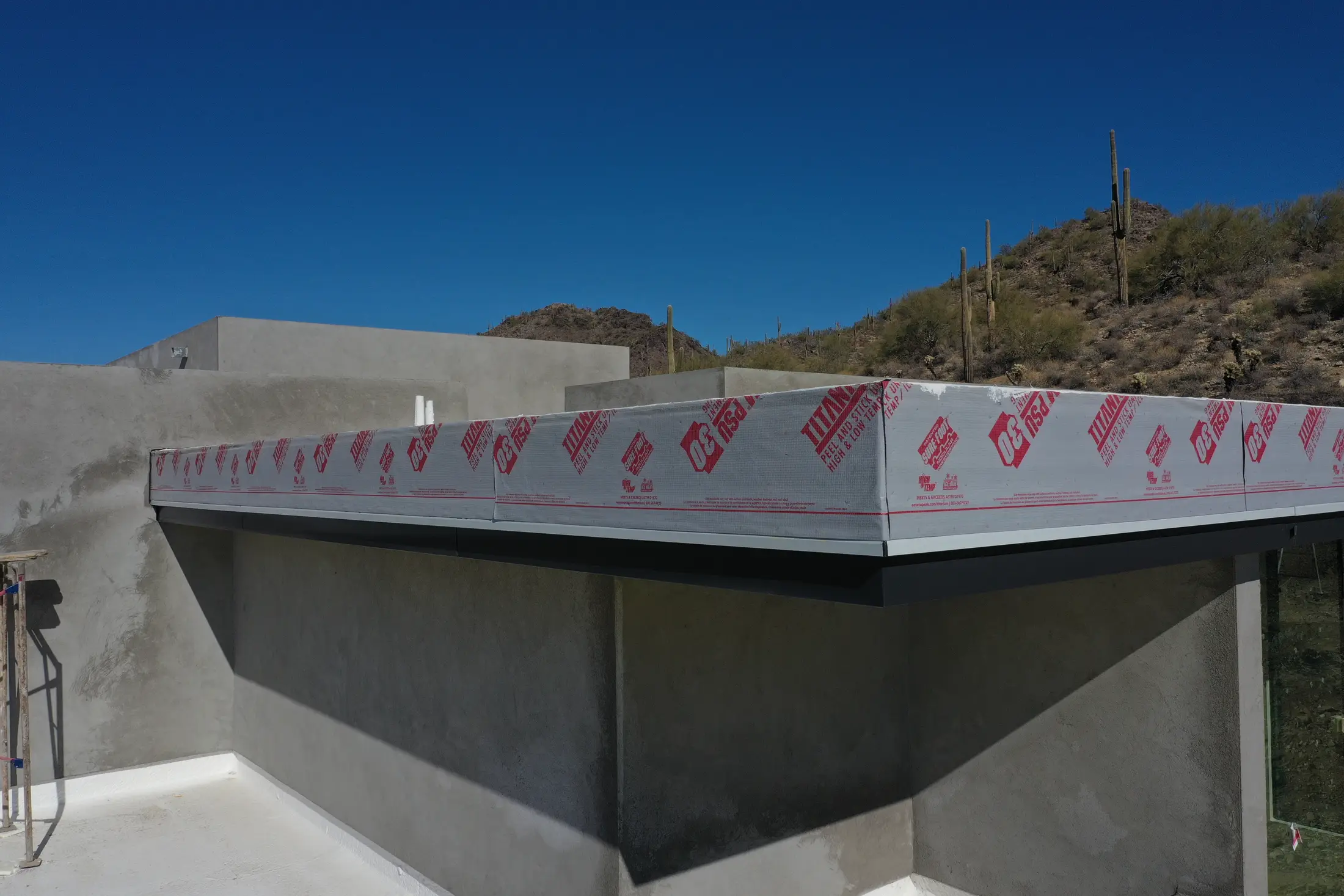
Most Phoenix retail architecture is flat roof behind a parapet, drained through scuppers, and that geometry is exactly where these roofs fail. Parapet caps open at the joints under thermal cycling, the wall-to-roof flashing behind them gives up, and scuppers clog or rust through, backing monsoon water onto the roof until it finds a way inside, usually above a tenant's sales floor. This is detail metal work, and we fabricate it ourselves: parapet caps, scupper boxes and liners, and wall flashing formed in our shop and on mobile brakes to the building's actual dimensions rather than adapted from stock parts. When we recoat or re-foam a retail roof, the parapet and drainage details are rebuilt as part of the scope, because a new surface draining through failed scuppers is money wasted.
- Parapet caps and coping fabricated in-house and fitted to the wall
- Scupper repair, relining, and replacement for monsoon drainage
- Wall-to-roof flashing at parapets, signage, and facade transitions
- Foam and coating systems for the field of the roof
HVAC Penetrations and Rooftop Congestion
Retail and restaurant roofs are crowded: package units for every suite, kitchen exhaust fans, makeup air units, gas lines, and conduit runs, each one a penetration through the waterproofing. Foam handles this congestion better than any seamed membrane because it self-flashes around every curb and pipe as it's applied, and it's a large part of why we recommend foam for most Valley retail roofs. On existing roofs, the boots, curbs, and pitch pans around equipment are the first things we inspect and the most common repairs we make. When a tenant's HVAC contractor changes out a unit, we're the follow-up call that makes sure the roof around the new curb is actually sealed. Restaurant roofs add a wrinkle of their own: grease from kitchen exhaust degrades many roofing materials and coatings over time, so we detail grease containment at exhaust fans and check those zones on every inspection, because a grease-softened patch of roof around a fan curb is one of the most common restaurant leaks we find.
Coordinated with Tenant Improvements and Storefront Protection
A tenant turnover is often the right moment to deal with the roof: the suite is empty, the GC is already mobilized, and new equipment is going up anyway. We coordinate roof scope with tenant improvement schedules so penetrations for new kitchen equipment or HVAC land in fresh, properly flashed roofing instead of being cut into a surface someone just paid to restore. For landlords, that coordination also settles the roof-responsibility question cleanly: the penetrations made for the tenant's equipment are documented, flashed, and photographed at turnover, so there's a record of what was cut and who sealed it if a leak shows up two years into the lease. Throughout any retail project, ground protection is part of the plan: covered walkways or barricades where overhead work crosses entries, signage kept visible, and no debris or equipment where a customer or a delivery could meet it.
How it works
Retail Roofing: what to expect
- Step 1
Assessment with photo documentation
We inspect the field, parapets, scuppers, and every penetration, and document conditions suite by suite where it matters.
- Step 2
Written proposal
An itemized scope with options, sequencing, and the business-hours plan spelled out for you and your tenants.
- Step 3
Scheduled, sectioned work
Work proceeds in sections with loud phases placed outside business hours and storefront protection in place throughout.
- Step 4
Closeout and warranty
Final walkthrough, photo report for the property file, and warranty registration.
FAQ
Retail Roofing FAQs
Can you roof our building without closing the businesses below?
That's the default plan, not a special request. Loud work runs before opening or after close, the roof is sectioned so no suite sits under open deck during business hours, and storefronts and customer parking stay protected and usable throughout.
Why do our scuppers and parapets keep leaking?
Because that's where flat-behind-parapet retail roofs fail. Cap joints open under thermal cycling, the flashing behind the parapet gives up, and scuppers clog or corrode until monsoon water backs onto the roof. We fabricate caps, scupper liners, and flashing in-house and rebuild those details as part of any roof scope.
Can you work around a restaurant's service hours?
Yes. We schedule around service periods, mask intakes so coating and foam odors stay out of kitchens and dining rooms, and time the messiest work for hours the restaurant is closed.
Should we handle the roof during a tenant improvement?
Often, yes. The suite is empty and new equipment penetrations are coming anyway. We coordinate with your TI contractor so new curbs and vents land in properly flashed roofing instead of being cut into finished work later.
Related
Above the Standard
Free Retail Roofing Estimate
Tell us what the roof is doing and we will take a look. Licensed Arizona contractor, AZ ROC #161685, serving the Phoenix metro since 1999.